Optimize electrochemical parameters across multiple discharge rates and temperatures simultaneously. Achieve high-fidelity model calibration using our balanced multi-dataset optimization engine.
To solve the high-dimensional inverse problem, we decouple the parameters into four distinct physical steps based on their sensitivity to C-rate and temperature.
Aligns the electrode utilization windows and OCP curves. Must be performed at a near-equilibrium state (e.g., 0.05C).
lowerVoltageCutoff. This ensures the simulation terminates at the
exact same boundary condition as the experiment.electrodeWidth internally) rather
than arbitrarily changing both thicknesses. The anode thickness (L_n) is completely
locked because it typically dominates electrolyte resistance. The cathode
thickness (L_p) is allowed to float slightly to fine-tune the N/P ratio. If you
want to force the Area to remain fixed, you should manually adjust the Active Material Fraction
or Porosity instead.
Calibrates the overpotential and voltage slope at moderate currents (e.g., 1C).
Captures salt depletion and liquid-phase potential drops. Crucial for the high-rate "knee".
Determines activation energies ($E_a$). Requires data at varied temperatures (e.g., 0°C, 45°C).
We normalize each dataset's contribution by calculating the Average MSE per dataset. This ensures that curves with fewer points (high rate) are not overshadowed by curves with many points (low rate).
A strong Penalty Term is applied if the simulation's capacity deviates from the experiment, guiding the optimizer toward physically consistent stoichiometry.
To avoid local minima, the engine launches from several random initial points simultaneously, followed by a final polishing of the best result.
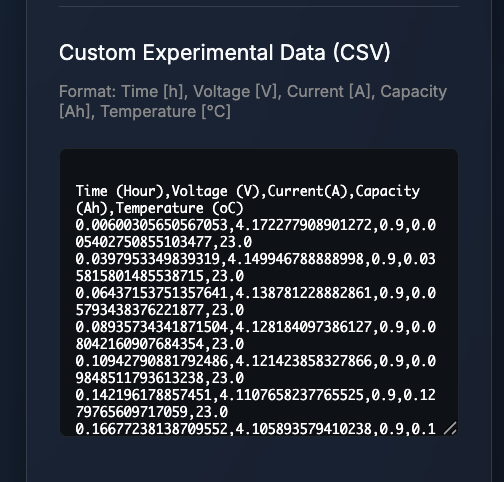
Format your CSV as Time(h), Voltage(V), Current(A), Capacity(Ah), Temp(C) and
paste it into the "Exp Data" tab.
Click "Update UserData". The tool automatically detects different conditions and generates selection buttons for fitting.
This fitting tool inherits the powerful visualization capabilities of the original Battery Simulator Web (SPMe), allowing you to not only fit data but deeply analyze the internal physical states during the process.
Isothermal Model Limitations: This model assumes a uniform, constant temperature. Fitting high-rate data where significant physical self-heating occurs will force the optimizer to learn unphysical parameters to compensate for the unmodeled temperature rise. Please use datasets obtained under stable thermal conditions.
Browser Constraints: Due to the heavy nature of running multi-start optimization within Web Workers, **your browser may temporarily freeze or become unresponsive** during intensive fitting cycles. This is an expected limitation of web apps. Please wait for the process to complete or reload the page if it hangs permanently.
高次元のパラメータ同定を成功させるため、物理現象の感度に応じて以下の4つのステップに分離して同定を行います。
電極の利用窓(ストイキオメトリ)とOCP曲線を合わせます。極低レート(0.05C等)で行います。
lowerVoltageCutoff)として適用します。これにより、シミュレーションは実験データと完全に同じ電圧境界条件で停止します。L_n)は完全に固定(Lock)され、正極厚み(L_p)のみがN/P比(極間容量比)の微調整のために動かされます。もし面積も実測値のまま固定したい場合は、フィッティング結果を手動で上書きし、「活物質体積率」や「空隙率」をマニュアル調整してください。
中レート(1C等)での過電圧と電圧降下の傾きを同定します。
液相のイオン移動制限を捉えます。高レート放電末期の電圧降下(Knee)に寄与します。
活性化エネルギー($E_a$)を同定します。異なる温度(例:0°C, 45°C)のデータが必要です。
各データセットの**「平均MSE」**を指標とすることで、点数が多い低レートデータが、重要度の高い高レートデータをかき消してしまうのを防ぎます。
容量がズレた場合に**強力なペナルティ**を課すことで、物理的に妥当な電極利用率(x100, y100)へ導きます。
複数の異なる初期点から**同時に最適化を開始(Multi-Start)**し、最も優れた結果をさらに磨き上げることで、グローバルな最適解を確実に捉えます。
エクセル等で Time(h), Voltage(V), Current(A), Capacity(Ah), Temp(C)
の5列に整理し、"Exp Data" タブに貼り付けます。
"Update UserData" をクリックすると、ツールがレートや温度を自動解析し、グラフ上部に**「データ選択ボタン」を自動生成**します。
本フィッティングツールは、ベースとなった Battery Simulator Web (SPMe) の強力な可視化機能を完全に継承しています。単なるカーブフィッティングにとどまらず、同定プロセス中の電池内部の物理状態を深く分析することが可能です。
@misc{kusachi2025fitting,
  author = {Yuki Kusachi},
  title = {SPMe Curve Fitting Tool (Electrochemical Parameter Identification)},
  year = {2025},
  url = {https://www.edandc.com/BattSimWeb-Fitting/},
  note = {YK Energy Device \& Consulting}
}