Logo

Battery Simulator Web - SPM

English 日本語

Single Particle Model Simulator

A fast, interactive web application exploring lithium-ion battery dynamics through the lens of electrochemical engineering.

Launch Simulator

Technical Overview: The Single Particle Model (SPM)

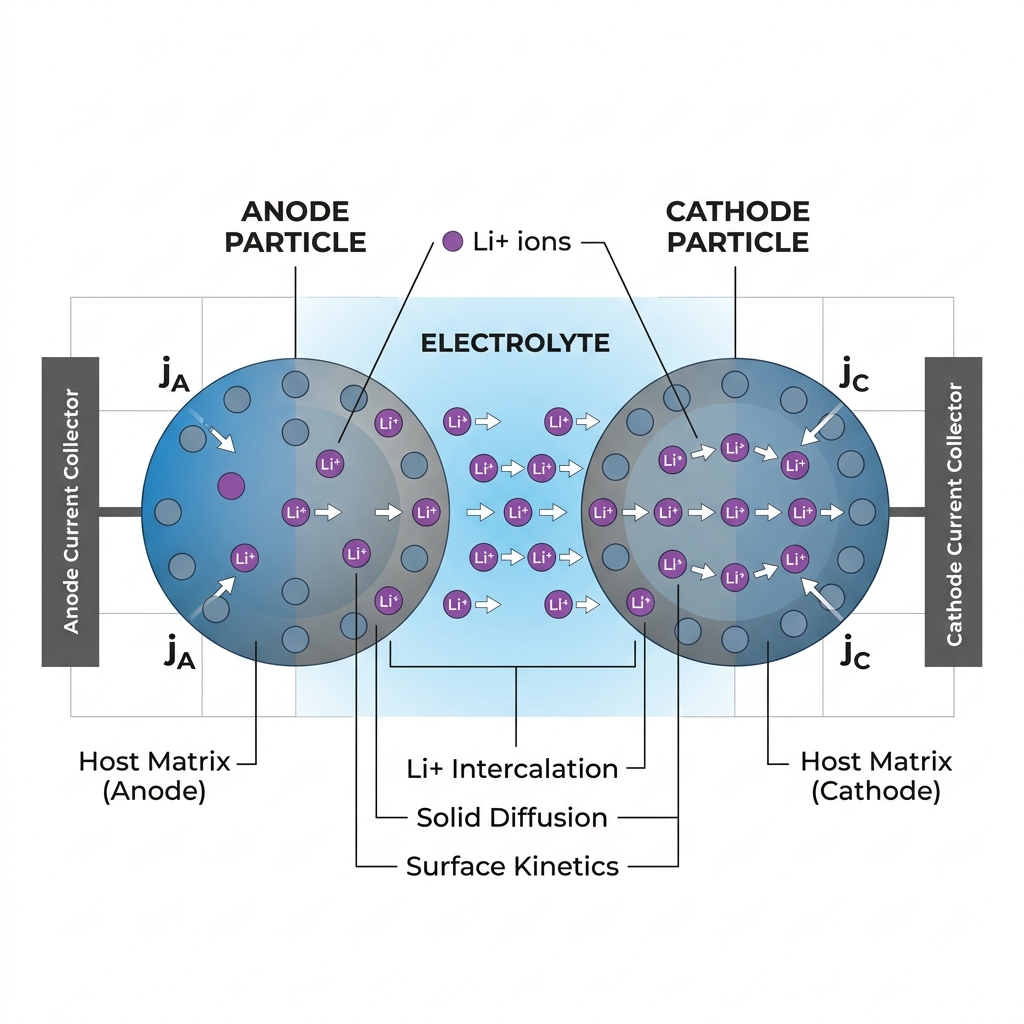
The Single Particle Model (SPM) is a fundamental electrochemical model used to predict the terminal voltage and internal state of a lithium-ion battery. It treats each electrode as a single representative spherical particle, simplifying the complex 3D structure of a cell into a computationally efficient form.
Electrochemical Assumptions

  • Solid Phase Diffusion: Models the movement of lithium ions within the active material particles using a polynomial approximation for surface concentration.
  • Surface Kinetics: Captures the exchange of lithium between the particle surface and the electrolyte.
  • Isothermal Operation: Temperature is assumed to be constant (e.g., 25°C) and uniform throughout the simulation.
SPM Diagram

Electrolyte Handling

In this SPM implementation, the electrolyte is treated as a uniform medium. This means:
  • Electrolyte concentration is assumed to be constant and sufficient at all times.
  • Potential drops across the electrolyte phase are neglected in the governing equations.
  • Transport limitations in the liquid phase are not modeled, focusing purely on solid-phase diffusion and reaction kinetics.
Model Limitations: By ignoring electrolyte-phase potential drops and thermal variables, the model is most accurate for low to moderate C-rates (< 2C). For high-power scenarios, more advanced models like P2D would be required to capture liquid-phase transport and heat generation.

How to Use

Simulator UI

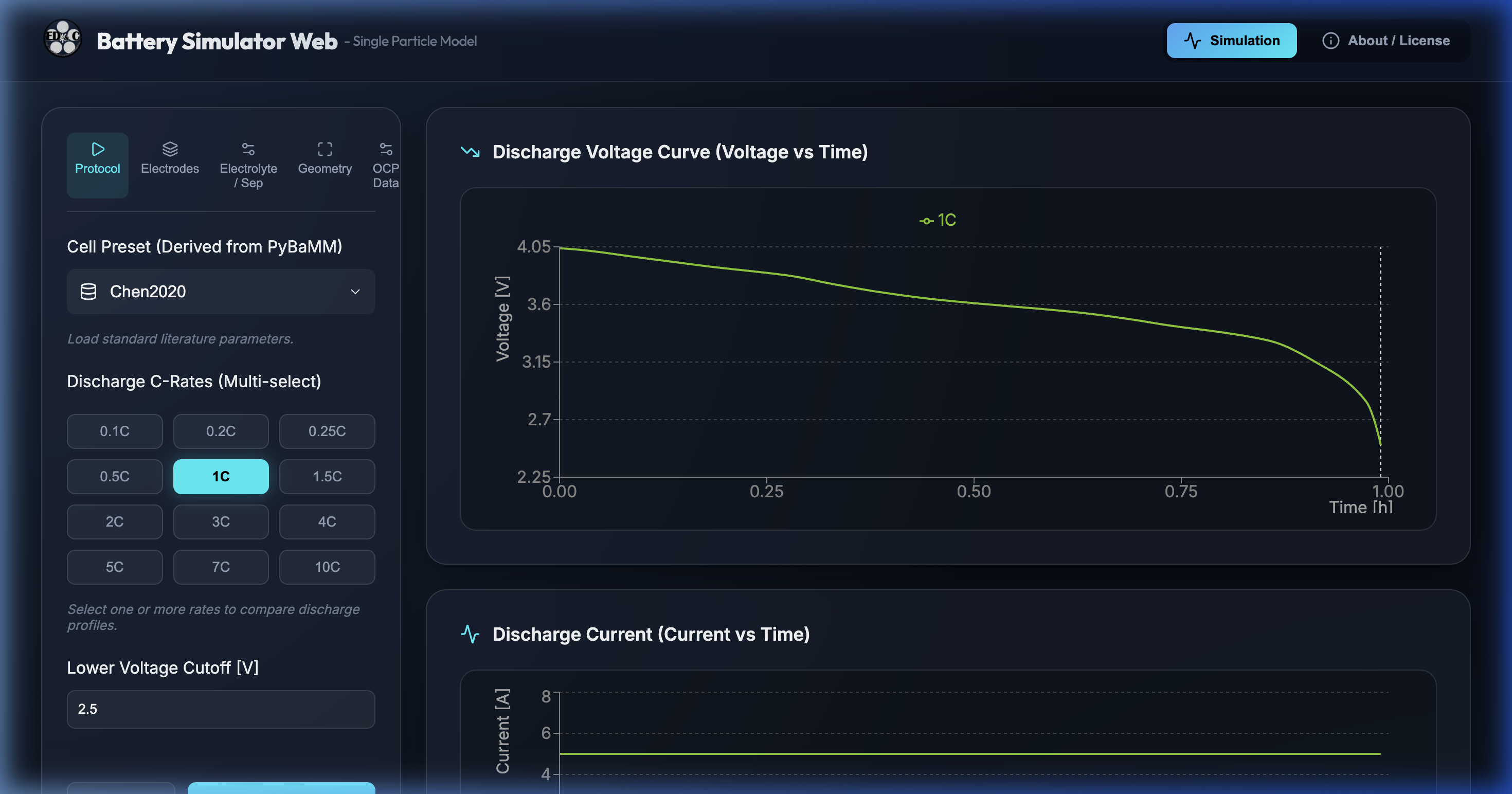
The simulator provides a straightforward interface to explore how different battery designs perform under load.

Operation Guide

  1. Select a Preset: Choose a standard battery chemistry (e.g., Chen2020) to load literature-verified parameters.
  2. Adjust Parameters: Navigate through the tabs (Electrodes, Electrolyte, Geometry, OCP) to fine-tune specific physical properties.
  3. Multi-Rate Comparison: Select multiple C-rates (from 0.1C up to 10C) to visualize and compare discharge behavior simultaneously.

Observe how changes in thickness, particle size, or porosity immediately affect the voltage plateau and available capacity in the resulting charts.

Background & Motivation

Battery simulation is often a barrier for many due to the complexity of scripts and commercial tools. This application aims to make battery design intuitive and accessible, allowing anyone to visualize the inner workings of a lithium-ion cell directly in their browser.

By providing a simple way to experience how "tweaking" a parameter shifts a battery's performance, I hope to foster a deeper understanding of the trade-offs involved in energy storage technology.

References & Acknowledgements

This simulator is built using electrochemical principles and is greatly inspired by the PyBaMM (Python Battery Mathematical Modelling) project, which provides a world-class open-source framework for battery modelling. We express our deep gratitude to the PyBaMM community for their pioneering work and for sharing the robust parameter sets used in this application.

Primary Software & Framework

  • PyBaMM: Sulzer et al. "Python Battery Mathematical Modelling (PyBaMM)." J. Open Source Softw. 6 (2021): 2980. pybamm.org

Academic Literature (Parameter Sources)

  • Chen2020 (LG M50): Chen et al. "Development of Experimental Techniques for Parameterization of Multi-scale Lithium-ion Battery Models." J. Electrochem. Soc. 167 (2020): 080534.
  • Marquis2019: Marquis et al. "An Upgraded Form of the Single-Particle Model with Electrolyte." J. Electrochem. Soc. 166 (2019): A3693.
  • Mohtat2020: Mohtat et al. "A Lithium-Ion Battery Prognostics Method." J. Electrochem. Soc. 167 (2020): 140536.
  • Kim2011 (NCA): Kim et al. "Multi-domain modeling of lithium-ion batteries encompassing multi-physics." J. Electrochem. Soc. 158 (2011): A955.
  • Ai2020: Ai et al. "Electrochemical Thermal-Mechanical Modelling of Stress Inhomogeneity in Lithium-Ion Pouch Cells." J. Electrochem. Soc. 167 (2020): 013512.
  • Ecker2015: Ecker et al. "Parameterization of a physico-chemical model of a lithium-ion battery." J. Electrochem. Soc. 162 (2015): A1836.
  • O'Kane2022: O’Kane et al. "Lithium-ion battery degradation: how to model it." Phys. Chem. Chem. Phys. 24 (2022): 7909.
  • O'Regan2022: O’Regan et al. "Thermal-electrochemical parameters of a high energy lithium-ion cylindrical battery." Electrochim. Acta 425 (2022): 140700.
  • Prada2013: Prada et al. "A simplified electrochemical and thermal aging model of LiFePO4-graphite Li-ion batteries." J. Electrochem. Soc. (2013).
  • Ramadass2004: Ramadass et al. "Development of first principles capacity fade model for Li-ion cells." J. Electrochem. Soc. 151 (2004): A196.
  • Xu2019: Xu et al. "A Lithium-Ion Battery NMC half-cell model." J. Electrochem. Soc. 166 (2019): A3456.

技術解説:単一粒子モデル (SPM)

単一粒子モデル (Single Particle Model, SPM) は、リチウムイオン電池の内部状態と端子電圧を予測するための基本的な電気化学モデルです。各電極を一つの代表的な球状粒子として扱うことで、複雑な電池の3次元構造を計算効率の高い形式に簡略化しています。

電気化学的な考慮点

  • 固体内拡散: 活物質粒子内でのリチウムイオンの移動を、表面濃度に対する多項式近似を用いてモデル化しています。
  • 界面反応動力学: 粒子表面と電解液の間でのリチウムの授受(充放電反応)を捉えています。
  • 等温動作: シミュレーション中、温度は一定(例:25℃)かつ均一であると仮定しています。
SPM Diagram

電解液の取り扱い

本SPMの実装では、電解液を均一な媒体として扱っています。具体的には以下の通りです:

  • 電解液濃度は常に一定であり、反応に十分な量が確保されていると仮定します。
  • 電解液相における電位降下(オーム損)は計算式から省略されています。
  • 液相での移動制限は考慮せず、固体内拡散と反応動力学のみに焦点を当てています。
モデルの限界: 電解液相の電位降下や温度変化を省略しているため、このモデルは低〜中レート(< 2C)で最も正確です。高出力時の液相移動制限や発熱の影響を考慮するには、P2Dモデルのような高度なモデルが必要になります。

シミュレータの使い方

Simulator UI

シミュレータは、異なる電池設計が負荷の下でどのように動作するかを、直感的なインターフェースで探索できるように設計されています。

操作ガイド

  1. プリセットの選択: Chen2020などの標準的な電池系を選択して、文献値に基づいたパラメータを読み込みます。
  2. パラメータ調整: 各タブ(Electrodes, Electrolyte, Geometry, OCP)を切り替えて、特定の物理特性を微調整できます。
  3. 複数レートの比較: 0.1Cから10Cまでの複数のレートを同時に選択して、放電挙動の変化を比較できます。

厚み、粒子径、空隙率などの変化が、電圧カーブや取り出せる容量にどう影響するかを即座にチャートで確認できます。

開発背景と想い

電池シミュレーションは通常、複雑なスクリプトや高価な商用ツールの影に隠れて、多くの人にとって敷居の高いものでした。このアプリケーションは、電池設計を直感的にし、誰でもブラウザ上でリチウムイオン電池の内部動作を可視化できるようにすることを目指しています。

パラメータを少し変えるだけで電池の性能がどう変化するかを体感してもらうことで、エネルギー貯蔵技術におけるトレードオフの深奥にある面白さを感じていただければ幸いです。

Reference & Acknowledgements (引用と謝辞)

本シミュレータは電気化学の原理に基づいて構築されており、電池モデリングの世界的なオープンソースフレームワークである PyBaMM (Python Battery Mathematical Modelling) プロジェクトから多大なインスピレーションを受けています。このアプリケーションで使用されている堅牢なパラメータセットを提供・公開しているPyBaMMコミュニティの先駆的な取り組みに、深く感謝いたします。

主要ソフトウェア・フレームワーク

  • PyBaMM: Sulzer et al. "Python Battery Mathematical Modelling (PyBaMM)." J. Open Source Softw. 6 (2021): 2980. pybamm.org

学術論文(パラメータ引用元)

  • Chen2020 (LG M50): Chen et al. "Development of Experimental Techniques for Parameterization of Multi-scale Lithium-ion Battery Models." J. Electrochem. Soc. 167 (2020): 080534.
  • Marquis2019: Marquis et al. "An Upgraded Form of the Single-Particle Model with Electrolyte." J. Electrochem. Soc. 166 (2019): A3693.
  • Mohtat2020: Mohtat et al. "A Lithium-Ion Battery Prognostics Method." J. Electrochem. Soc. 167 (2020): 140536.
  • Kim2011 (NCA): Kim et al. "Multi-domain modeling of lithium-ion batteries encompassing multi-physics." J. Electrochem. Soc. 158 (2011): A955.
  • Ai2020: Ai et al. "Electrochemical Thermal-Mechanical Modelling of Stress Inhomogeneity in Lithium-Ion Pouch Cells." J. Electrochem. Soc. 167 (2020): 013512.
  • Ecker2015: Ecker et al. "Parameterization of a physico-chemical model of a lithium-ion battery." J. Electrochem. Soc. 162 (2015): A1836.
  • O'Kane2022: O’Kane et al. "Lithium-ion battery degradation: how to model it." Phys. Chem. Chem. Phys. 24 (2022): 7909.
  • O'Regan2022: O’Regan et al. "Thermal-electrochemical parameters of a high energy lithium-ion cylindrical battery." Electrochim. Acta 425 (2022): 140700.
  • Prada2013: Prada et al. "A simplified electrochemical and thermal aging model of LiFePO4-graphite Li-ion batteries." J. Electrochem. Soc. (2013).
  • Ramadass2004: Ramadass et al. "Development of first principles capacity fade model for Li-ion cells." J. Electrochem. Soc. 151 (2004): A196.
  • Xu2019: Xu et al. "A Lithium-Ion Battery NMC half-cell model." J. Electrochem. Soc. 166 (2019): A3456.

Cite This Simulator (BibTeX)

@misc{kusachi2025spm,
  author = {Yuki Kusachi},
  title = {Battery Simulator Web - SPM (Single Particle Model)},
  year = {2025},
  url = {https://www.edandc.com/BattSimWeb-SPM/},
  note = {YK Energy Device \& Consulting}
}