Logo

Battery Simulator Web - SPMe

English 日本語

Single Particle Model with Electrolyte (SPMe)

A fast, interactive web application exploring lithium-ion battery dynamics including electrolyte transport and temperature sensitivity.

Launch Simulator

Technical Overview: The SPMe Model

The Single Particle Model with Electrolyte (SPMe) is an upgraded version of the SPM. While it still treats each electrode as representative particles, it incorporates the dynamics of the electrolyte phase, providing a more realistic prediction of battery behavior at higher C-rates.
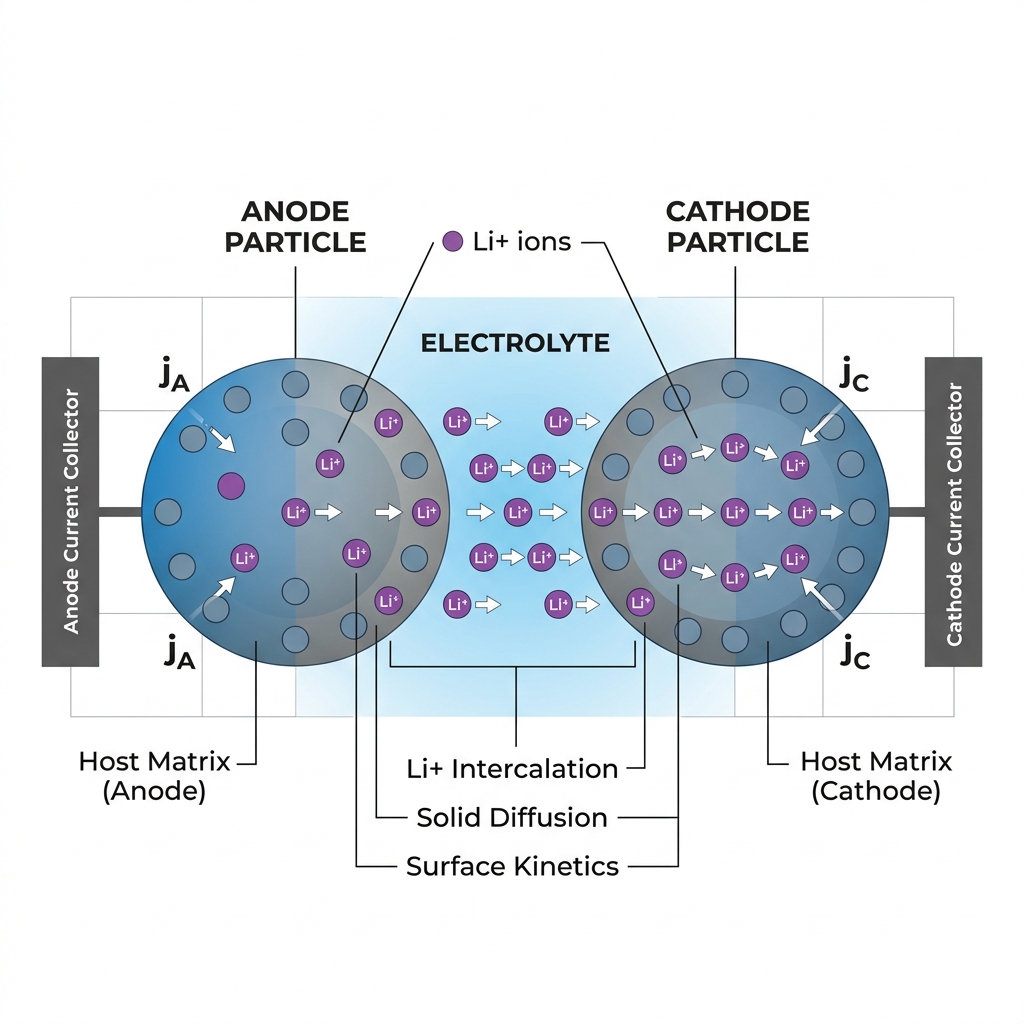
Electrochemical Scope

  • Solid Phase Diffusion: Models lithium movement within active material particles using polynomial approximations.
  • Electrolyte Dynamics: Captures concentration gradients and potential drops (ohmic and diffusion-polarization) across the electrolyte phase.
  • Isothermal Temperature Control: Users can set a constant operating temperature. The model automatically scales physical properties (diffusivity, conductivity, etc.) using Arrhenius relations.
SPM Diagram

Physics and Assumptions

By upgrading to SPMe, the simulator captures essential transport limitations:
  • Liquid Phase Transport: Electrolyte concentration is volume-averaged in three regions (anode, separator, cathode) to resolve dynamics.
  • Voltage Loss: Terminal voltage calculation includes kinetic overpotentials, electrolyte ohmic loss, and concentration-driven potential drops.
  • Kinetic Scaling: Exchange current densities and transport coefficients are temperature-sensitive, allowing exploration of cold-start or high-temp performance.
Model Capability: The SPMe maintains excellent computational speed while significantly improving accuracy over the base SPM, especially for electrolytes with low ionic conductivity or under high-current discharge scenarios.

How to Use

Simulator UI

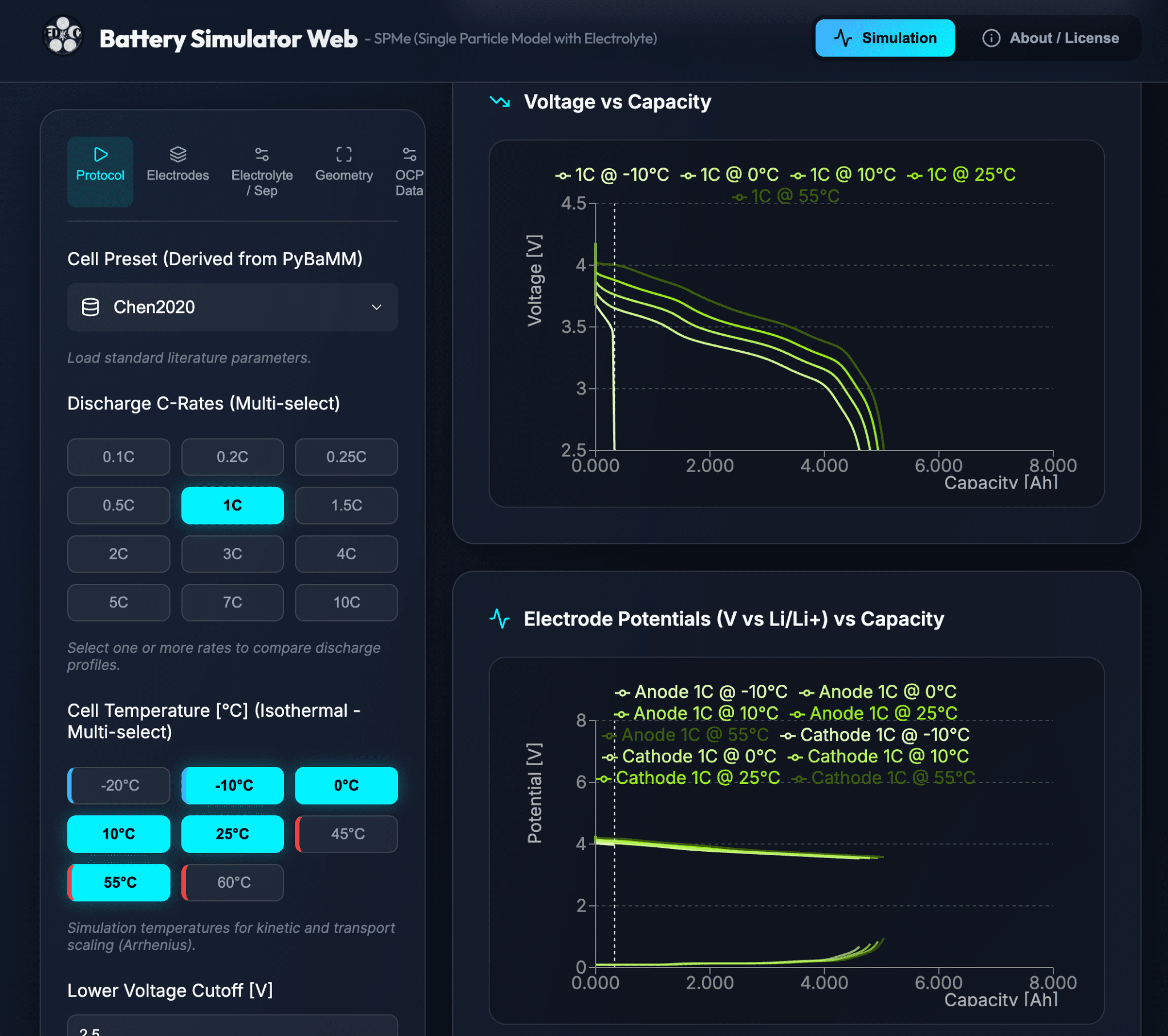
The simulator provides a straightforward interface to explore how different battery designs perform under load.

Operation Guide

  1. Select a Preset: Choose a standard battery chemistry (e.g., Chen2020) to load literature-verified parameters.
  2. Set Temperature: Adjust the ambient temperature to see how the battery's internal resistance and capacity shift.
  3. Adjust Parameters: Fine-tune physical properties like thickness, porosity, or particle radius.
  4. Multi-Rate Comparison: Compare discharge behavior across multiple C-rates simultaneously.

Background & Motivation

Battery simulation is often a barrier for many due to the complexity of scripts and commercial tools. This application aims to make battery design intuitive and accessible, allowing anyone to visualize the inner workings of a lithium-ion cell directly in their browser.

By providing a simple way to experience how "tweaking" a parameter shifts a battery's performance, I hope to foster a deeper understanding of the trade-offs involved in energy storage technology.

References & Acknowledgements

This simulator is built using electrochemical principles and is greatly inspired by the PyBaMM (Python Battery Mathematical Modelling) project. We express our deep gratitude to the PyBaMM community for their pioneering work and for sharing the robust parameter sets used in this application.

Primary Software & Framework

  • PyBaMM: Sulzer et al. "Python Battery Mathematical Modelling (PyBaMM)." J. Open Source Softw. 6 (2021): 2980. pybamm.org

Academic Literature (Parameter Sources)

  • Chen2020: Chen et al. "Development of Experimental Techniques for Parameterization of Multi-scale Lithium-ion Battery Models." J. Electrochem. Soc. 167 (2020): 080534.
  • Marquis2019: Marquis et al. "An Upgraded Form of the Single-Particle Model with Electrolyte." J. Electrochem. Soc. 166 (2019): A3693.
  • Landesfeind2019: Landesfeind et al. "Temperature and Concentration Dependence of the Ionic Transport Properties of Lithium-Ion Battery Electrolytes." J. Electrochem. Soc. 166 (2019) A3079.
  • O'Regan2022: O’Regan et al. "Thermal-electrochemical parameters of a high energy lithium-ion cylindrical battery." Electrochim. Acta 425 (2022): 140700.

技術解説:SPMeモデル(電解液を含む単一粒子モデル)

SPMe (Single Particle Model with Electrolyte) は、各電極内を代表的な粒子として扱う簡便さを維持しつつ、電解液相の濃度ダイナミクスと電位分布を考慮に加えた高度な電気化学モデルです。

主な考慮要素

  • 固体内拡散と液相移動: 活物質粒子内だけでなく、電解液内の濃度勾配に伴うリチウムイオンの移動制限を捉えます。
  • 電位降下(Overpotentials): 反応過電圧に加え、電解液のオーム損や拡散電位(液相抵抗)による電圧降下を計算に含めます。
  • 温度設定とArrheniusスケーリング: 等温(Isothermal)動作を仮定しつつ、ユーザーが温度を設定可能です。拡散係数や反応速度が温度に応じてArrhenius式に基づき動的に変化します。
SPM Diagram

モデルの物理的特徴

本実装では、SPMをSPMeに拡張したことで以下の現象を再現可能です:

  • 電解液の枯渇・偏り: 高レート放電時に電解液のイオン移動が追い付かなくなり、電圧が急降下する挙動。
  • 温度依存特性: 低温下での内部抵抗増大や、高温下での反応活性化に伴う出力特性の変化。
  • 詳細な電圧損失の内訳: 端子電圧の低下が「反応」「液相抵抗」「固体内拡散」のどれに起因するかを分離して理解できます。
モデルの優位性: 計算負荷の低さを保ちつつ、液相の移動制限を考慮できるため、従来のSPMでは対応できなかった高レート(> 2C)や低温環境下のシミュレーション精度が大幅に向上しています。

シミュレータの使い方

Simulator UI

厚み、粒子径、空隙率などの設計パラメータに加え、**「動作温度」**が性能にどう影響するかを直感的に探索できます。

操作ガイド

  1. プリセットの選択: Chen2020などの標準的な電池系を選択して、文献値に基づいたパラメータを読み込みます。
  2. 温度の設定: 動作温度を変更し、低温時の性能低下や容量制限の現れ方を確認します。
  3. パラメータ調整: 電極の厚みや空隙率を調整し、エネルギー密度と入出力特性のトレードオフを検討します。
  4. 複数レートの比較: 異なる放電レート(C-rate)を同時にプロットして比較できます。

Reference & Acknowledgements (引用と謝辞)

本シミュレータは、電池モデリングの世界的オープンソースプロジェクトである PyBaMM (Python Battery Mathematical Modelling) から多大なインスピレーションを受けています。PyBaMMコミュニティが公開している堅牢なパラメータセットと物理モデルのフレームワークに、深く感謝いたします。

Cite This Simulator (BibTeX)

@misc{kusachi2025spme,
  author = {Yuki Kusachi},
  title = {Battery Simulator Web - SPMe (Single Particle Model with Electrolyte)},
  year = {2025},
  url = {https://www.edandc.com/BattSimWeb-SPMe/},
  note = {YK Energy Device \& Consulting}
}