Logo

Battery Simulator Web - Electrolyte DNN + SPMe

English 日本語

Electrolyte DNN + SPMe Battery Simulator

An interactive web application combining a surrogate Deep Neural Network (DNN) for electrolyte property estimation with a Single Particle Model with Electrolyte (SPMe) solver.

Launch Simulator

Technical Overview: SPMe & Electrolyte DNN

The Single Particle Model with Electrolyte (SPMe) is an electrochemical model that simplifies battery dynamics for computational efficiency while incorporating electrolyte transport. Unlike the standard Single Particle Model (SPM), the SPMe approximates concentration gradients and electrical potential drops within the liquid electrolyte phase.
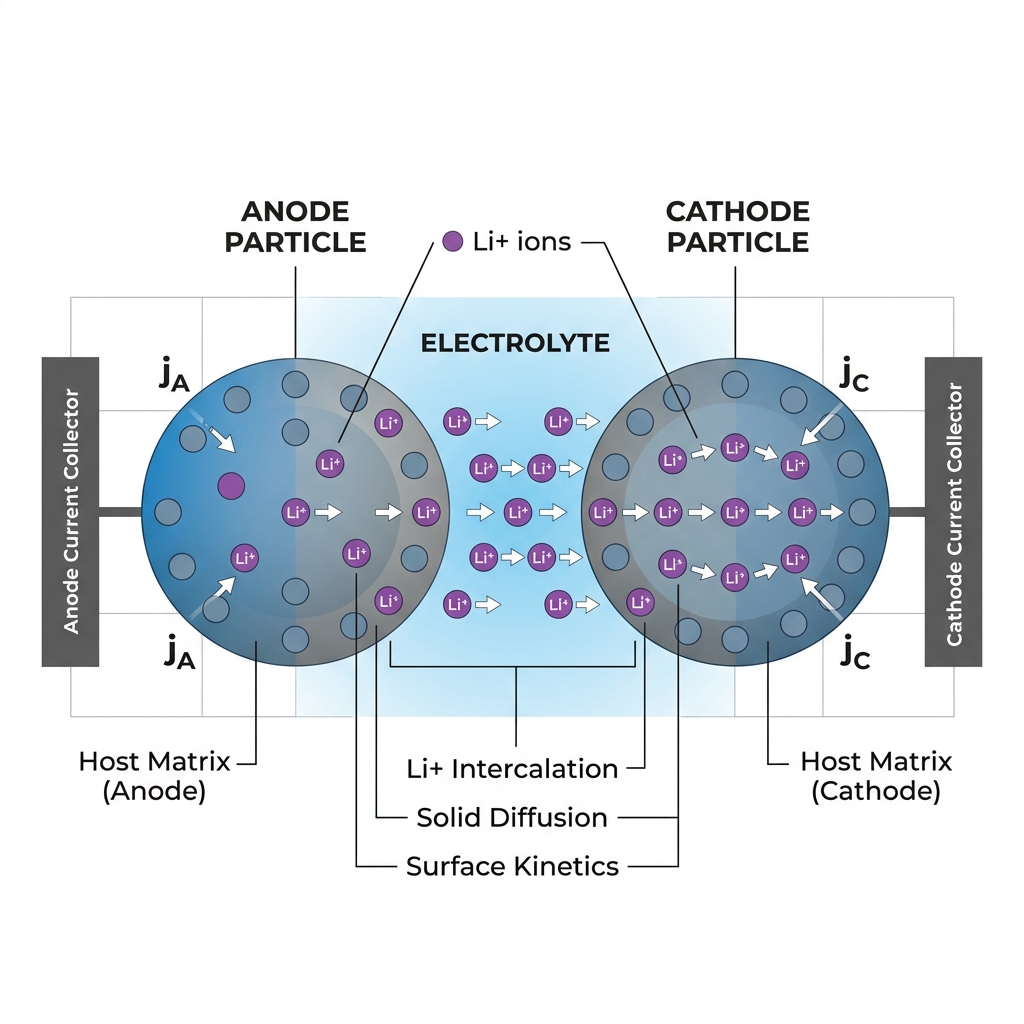
Model Components & Assumptions

  • Electrolyte Transport: Approximates salt concentration profiles and phase potentials (Ohmic losses and concentration overpotentials) across the cell thickness.
  • DNN Surrogate Model: Uses a pre-trained Deep Neural Network (DNN) as a surrogate model to interpolate electrolyte properties (ionic conductivity, diffusion coefficients, and cation transference number) based on the input 5-solvent ratio and salt concentration.
  • Solid Phase Physics: Simulates solid-phase lithium diffusion and Butler-Volmer reaction kinetics on representative active material particles.
SPM/SPMe Diagram

Key Features & Core Workspaces

1. Simulation Workspace (Single Run Analysis)

Focuses on simulating a single cell chemistry under user-defined operating protocols. By selecting the DNN option under the Electrolyte settings tab, you can customize the solvent composition and salt concentration to evaluate custom electrolyte configurations.
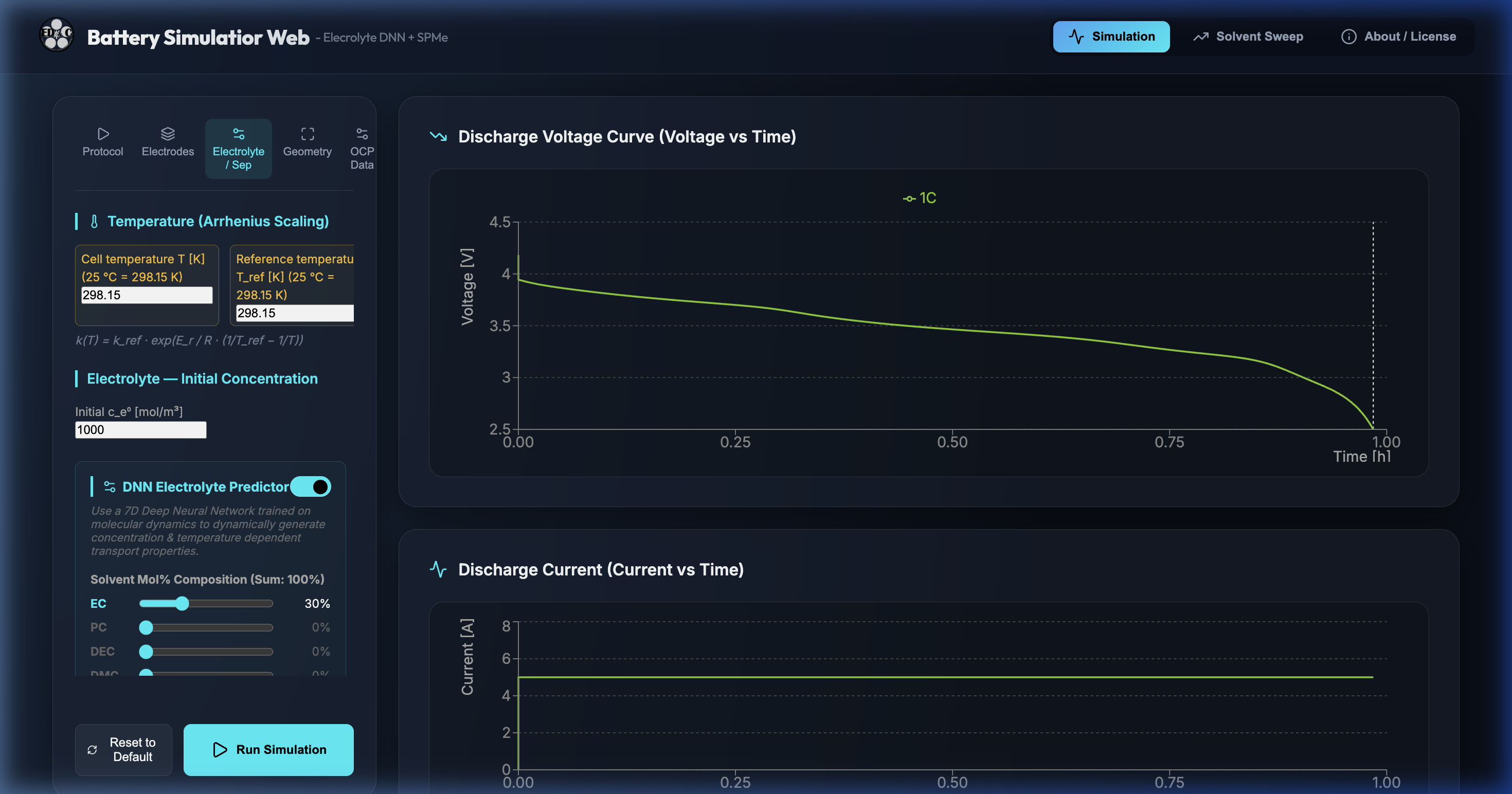
Simulation Tab Screenshot
  • Preset Selection: Load parameters based on literature references, such as Chen2020 (LG M50) and Prada2013 (LFP).
  • Electrolyte Tuning: Set composition ratios for up to 5 solvents (EC, PC, DEC, DMC, EMC) and the salt concentration. The DNN surrogate model estimates the corresponding electrolyte properties.
  • Internal State Visualization: View simulated internal state profiles, including solid-phase lithium concentrations, overpotential breakdowns (Activation, Ohmic, and Concentration overpotentials), and electrolyte concentration profiles across the cell.

2. Solvent Sweep Workspace (Composition Sweep & Optimization)

Enables systematic sweeps over electrolyte solvent ratios to study their impact on simulated cell performance. This workspace offers tools for batch simulations and heuristic optimization.

A. Binary Solvent Blend Performance Sweep

Runs batch simulations of cell discharge across a range of binary mixtures (from 0% to 100% ratio of two selected solvents) to observe how calculated capacity and energy change with the mixing ratio.
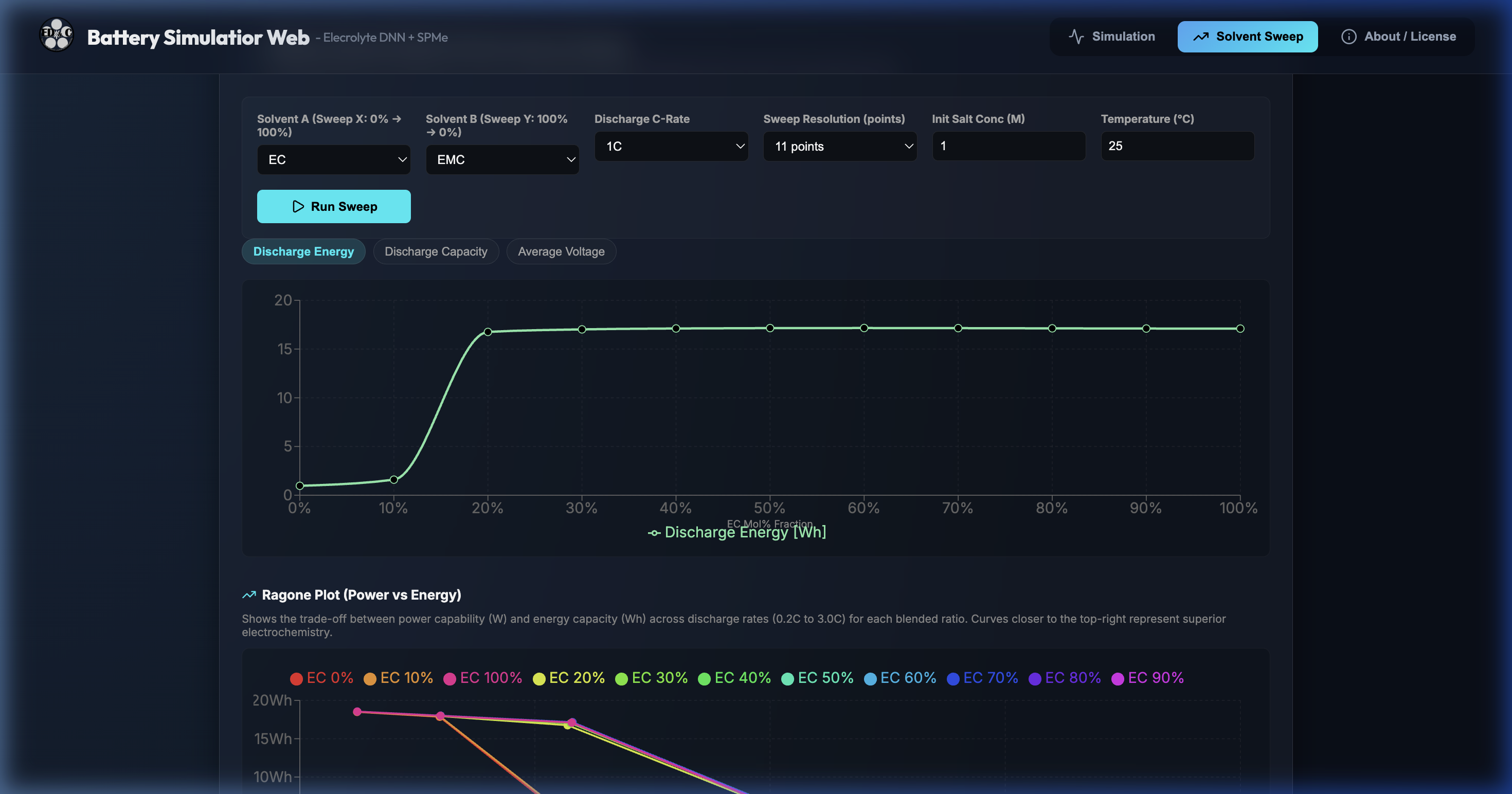
Binary Solvent Sweep Screenshot
B. Ternary Solvent Blend Performance Sweep

Sweeps a three-solvent mixture (e.g., EC-DMC-EMC) and maps the simulated discharge performance onto a ternary diagram. It highlights composition regions where the model predicts local salt depletion under the simulated discharge rate.
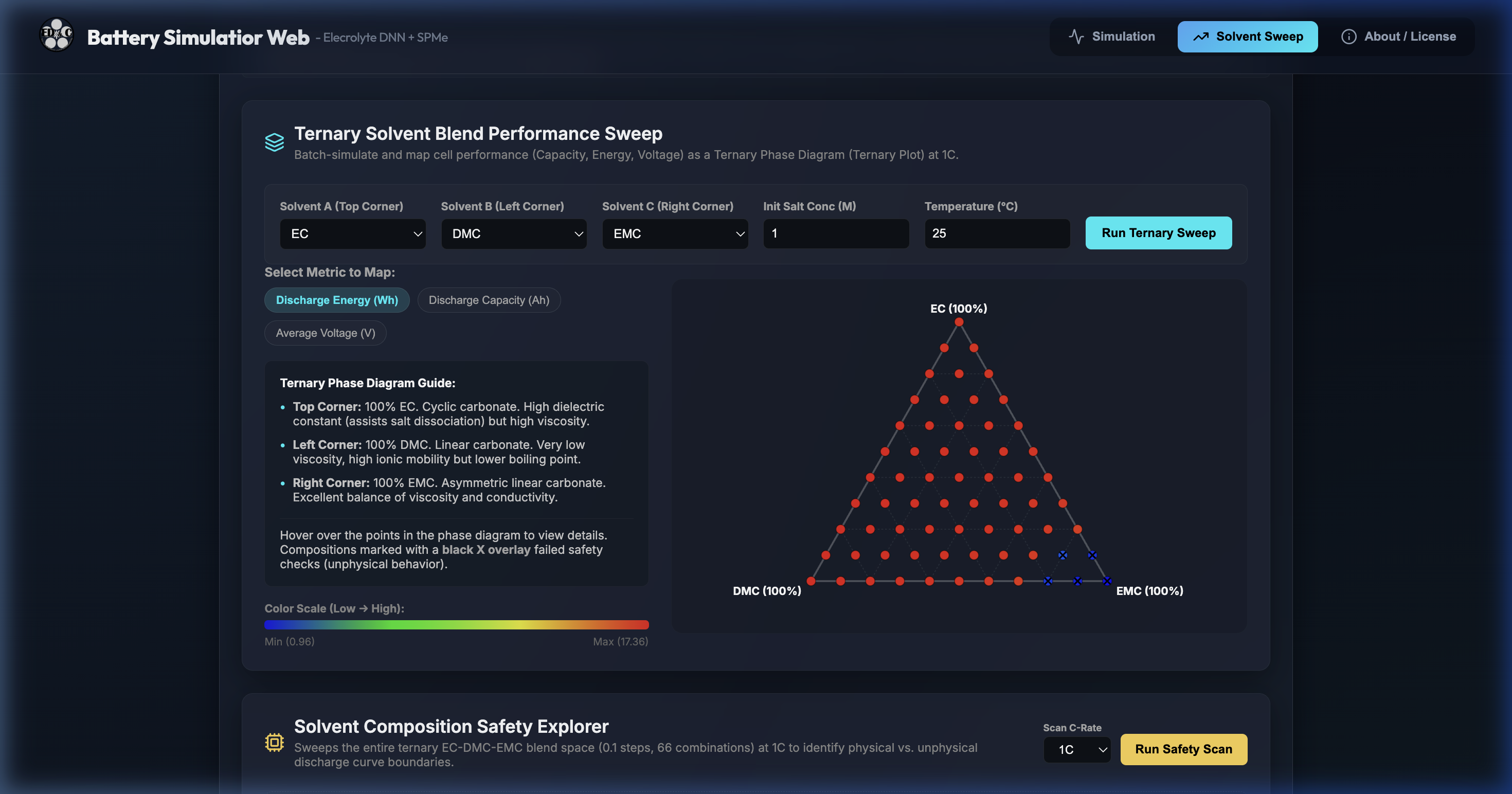
Ternary Solvent Sweep Screenshot
C. Rate Capability & Power Density Optimization (PSO)

Applies a Particle Swarm Optimization (PSO) heuristic combined with binary search loops to find candidate solvent ratios and salt concentrations that maximize the predicted limiting C-rate. Results are visualized on a Ragone Plot showing the candidate configurations and their calculated limits.
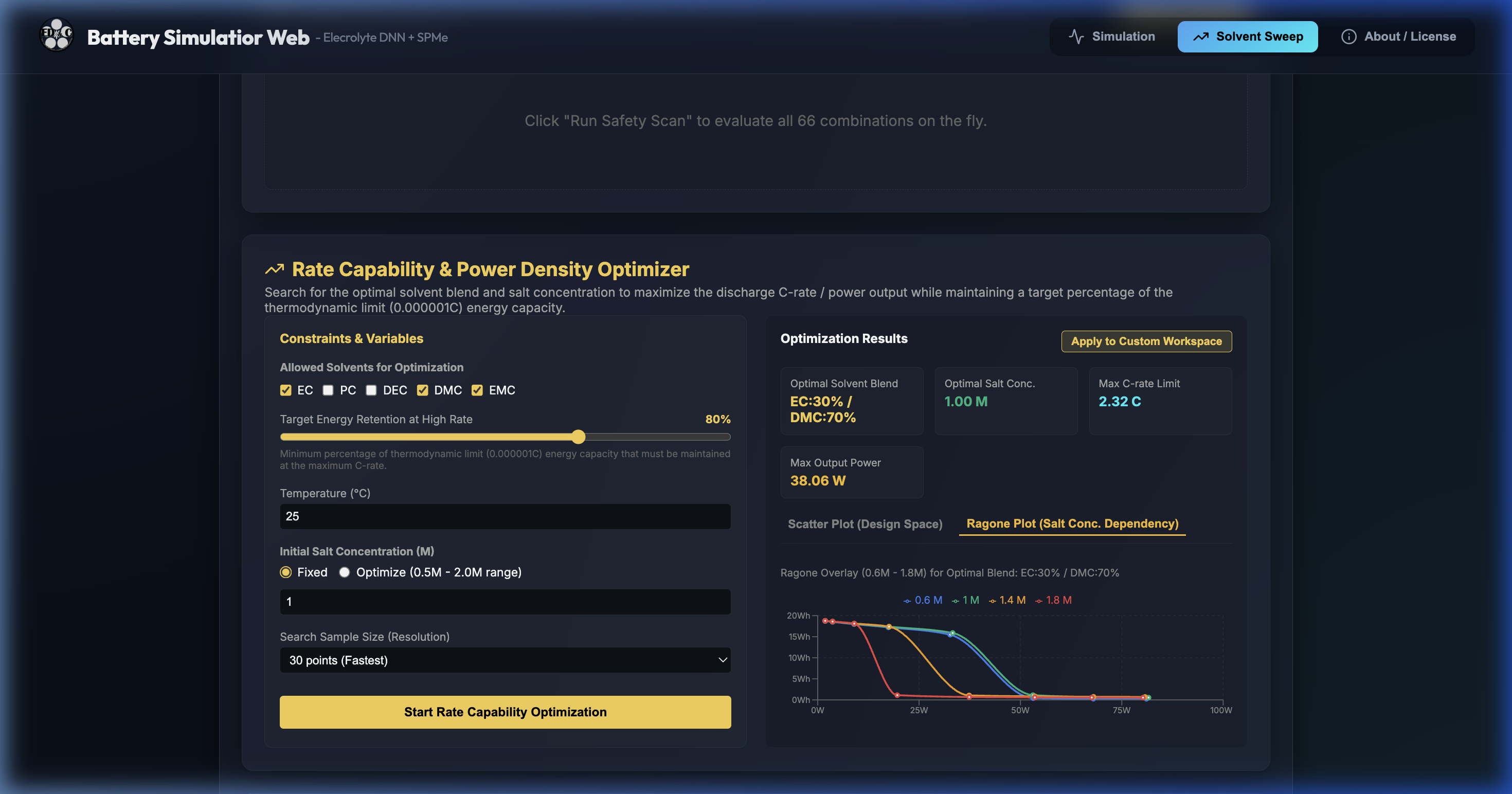
PSO Optimizer Screenshot

References & Academic Citations

This simulator is built upon standard electrochemical equations, referencing PyBaMM parameter definitions and battery literature.

Primary Software & Framework

  • PyBaMM: Sulzer et al. "Python Battery Mathematical Modelling (PyBaMM)." J. Open Source Softw. 6 (2021): 2980. pybamm.org

Academic Parameter Publications

  • Chen2020 (LG M50): Chen et al. "Development of Experimental Techniques for Parameterization of Multi-scale Lithium-ion Battery Models." J. Electrochem. Soc. 167 (2020): 080534.
  • Prada2013 (LFP): Prada et al. "A simplified electrochemical and thermal aging model of LiFePO4-graphite Li-ion batteries." J. Electrochem. Soc. (2013).

Electrolyte DNN Training Data References (Cheminformatics & Physical Chemistry)

  • RDKit: Landrum, G. et al. "RDKit: Open-source cheminformatics." (2006). rdkit.org
  • GFN2-xTB: Bannwarth, C., Ehlert, S., & Grimme, S. "GFN2-xTB—An Accurate and Broadly Parametrized Self-Consistent Tight-Binding Quantum Chemical Method with Multipole Electrostatics and Density-Dependent Dispersion Contributions." J. Chem. Theory Comput. 15 (2019): 1652–1671.
  • PACKMOL: Martínez, L. et al. "PACKMOL: A package for building initial configurations for molecular dynamics simulations." J. Comput. Chem. 30 (2009): 2157–2164.
  • Landesfeind & Gasteiger (2019): Landesfeind, J. & Gasteiger, H. A. "Temperature and Concentration Dependence of the Ionic Transport Properties of Lithium-Ion Battery Electrolytes." J. Electrochem. Soc. 166 (2019): A3079–A3097.
  • Thorat et al. (2009): Thorat, I. V. et al. "Temperature and Concentration Dependence of the Transport Properties of LiPF6 in Ethylene Carbonate:Propylene Carbonate." J. Phys. Chem. B 113 (2009): 7327–7337.
  • Valøen & Reimers (2005): Valøen, L. O. & Reimers, J. N. "Transport Properties of LiPF6-Based Li-Ion Battery Electrolytes." J. Electrochem. Soc. 152 (2005): A882–A891.

Electrolyte DNN Development & Deployment

  • PyTorch: Paszke, A. et al. "PyTorch: An Imperative Style, High-Performance Deep Learning Library." NeurIPS (2019). pytorch.org
  • ONNX: ONNX Project. "Open Neural Network Exchange (ONNX)." (2017). onnx.ai
  • ONNX Runtime Web: Microsoft. "ONNX Runtime: Cross-platform, high-performance ML inferencing engine." (2021). onnxruntime.ai
  • SciPy: Virtanen, P. et al. "SciPy 1.0: Fundamental Algorithms for Scientific Computing in Python." Nature Methods 17 (2020): 261–272.
  • NumPy: Harris, C. R. et al. "Array programming with NumPy." Nature 585 (2020): 357–362.
  • Pandas: McKinney, W. "Data Structures for Statistical Computing in Python." Proc. 9th Python Science Conf. (2010): 51–56.
  • MathJax: Cervone, D. et al. "MathJax: A JavaScript display engine for mathematics." (2010). mathjax.org

技術解説:SPMeと電解液物性予測DNN

SPMe (Single Particle Model with Electrolyte) は、計算負荷を低く抑えるために電池内の物理現象を簡略化しつつ、電解液輸送の効果を取り入れた電気化学モデルです。従来のSPM(単一粒子モデル)とは異なり、液相電解液中の塩濃度勾配や電位降下(液相オーム抵抗および濃度過電圧)を近似方程式を用いて考慮します。

モデルの特徴と仮定

  • 電解液内の輸送現象: セル厚み方向における塩の濃度分布や液相電位変化を一次元的に近似計算し、高負荷放電時の挙動などを評価します。
  • DNNサロゲートモデルによる物性値補間: 事前学習済みのディープニューラルネットワーク (DNN) をサロゲートモデルとして用い、入力された5溶媒組成比(EC, PC, DEC, DMC, EMC)と塩濃度から電解液物性(イオン導電率、拡散係数、陽イオン輸率)を内挿近似します。
  • 固相物理モデル: 活物質粒子内におけるリチウムの拡散挙動とButler-Volmer式に基づく電極反応キネティクスを考慮します。
SPM/SPMe Diagram

主要機能とワークスペースの構成

1. シミュレーション(単一セル計算)

ユーザー定義の運転条件のもとで、特定の単一セル構成の放電挙動を計算・評価します。電解液設定で「DNN」を選択することで、電解液組成比と塩濃度をカスタマイズしたシミュレーションを実行できます。

Simulation Tab Screenshot
  • プリセット選択: 文献値に基づくパラメータセット **Chen2020 (LG M50)** および **Prada2013 (LFP)** をロードできます。
  • 電解液組成の調整: 最大5種類の溶媒比率や塩濃度をスライダーで変更できます。DNNサロゲートモデルが、設定された組成に対応する物性値を算出します。
  • 内部プロファイルの可視化: 固相内のリチウム濃度分布、各種過電圧(活性化、液相オーム、濃度過電圧)の算出内訳、セル厚み方向の塩濃度プロファイルを描画します。

2. 電解液スイープ(組成変化の影響評価とヒューリスティック探索)

電解液の溶媒比率や塩濃度を変化させた際に、シミュレーション上の電池性能(算出容量、エネルギー、推定限界Cレート)が受ける影響を可視化し、指定条件下で好適な組成の探索を行います。

A. 二成分電解液スイープシミュレーション

選択した2種類の溶媒比率を0%〜100%の間で変化させ、放電容量、エネルギー、平均電圧の変化を示す2次元曲線を描画し、混合比率に伴う計算値のトレンドを評価します。

Binary Solvent Sweep Screenshot
B. 三成分電解液スイープシミュレーション

3種類の溶媒(例: EC-DMC-EMC)の混合比を変化させ、三成分相図(Ternary Phase Diagram)上に出力性能の推定値を示すカラーマップを描画します。高負荷放電時に電解液中の塩枯渇(塩濃度が極端に低下する現象)が予測される領域は「X」印として重畳表示されます。

Ternary Solvent Sweep Screenshot
C. 電解液組成の探索 (PSO)

5次元の溶媒比率と塩濃度空間を対象に、特定のエネルギー維持率を満たす最大放電Cレート(限界出力)を探索します。探索にはメタヒューリスティクス手法である **粒子群最適化 (PSO: Particle Swarm Optimization)** と二分探索法を組み合わせて使用し、探索された好適な組成案とラゴンプロットを提示します。

PSO Optimizer Screenshot

学術参考文献・引用

本シミュレータは、PyBaMMのパラメータ構造および電池関連文献に記載された基礎式に基づいて構築されています。

基盤フレームワーク

  • PyBaMM: Sulzer et al. "Python Battery Mathematical Modelling (PyBaMM)." J. Open Source Softw. 6 (2021): 2980. pybamm.org

パラメータ引用文献

  • Chen2020 (LG M50): Chen et al. "Development of Experimental Techniques for Parameterization of Multi-scale Lithium-ion Battery Models." J. Electrochem. Soc. 167 (2020): 080534.
  • Prada2013 (LFP): Prada et al. "A simplified electrochemical and thermal aging model of LiFePO4-graphite Li-ion batteries." J. Electrochem. Soc. (2013).

電解液物性値DNN教師データ作成リファレンス(量子化学・計算化学・電解液学術文献)

  • RDKit: Landrum, G. et al. "RDKit: Open-source cheminformatics." (2006). rdkit.org
  • GFN2-xTB: Bannwarth, C., Ehlert, S., & Grimme, S. "GFN2-xTB—An Accurate and Broadly Parametrized Self-Consistent Tight-Binding Quantum Chemical Method with Multipole Electrostatics and Density-Dependent Dispersion Contributions." J. Chem. Theory Comput. 15 (2019): 1652–1671.
  • PACKMOL: Martínez, L. et al. "PACKMOL: A package for building initial configurations for molecular dynamics simulations." J. Comput. Chem. 30 (2009): 2157–2164.
  • Landesfeind & Gasteiger (2019): Landesfeind, J. & Gasteiger, H. A. "Temperature and Concentration Dependence of the Ionic Transport Properties of Lithium-Ion Battery Electrolytes." J. Electrochem. Soc. 166 (2019): A3079–A3097.
  • Thorat et al. (2009): Thorat, I. V. et al. "Temperature and Concentration Dependence of the Transport Properties of LiPF6 in Ethylene Carbonate:Propylene Carbonate." J. Phys. Chem. B 113 (2009): 7327–7337.
  • Valøen & Reimers (2005): Valøen, L. O. & Reimers, J. N. "Transport Properties of LiPF6-Based Li-Ion Battery Electrolytes." J. Electrochem. Soc. 152 (2005): A882–A891.

電解液物性値DNN構築・実装用リファレンス(データサイエンス・機械学習・実装ライブラリ)

  • PyTorch: Paszke, A. et al. "PyTorch: An Imperative Style, High-Performance Deep Learning Library." NeurIPS (2019). pytorch.org
  • ONNX: ONNX Project. "Open Neural Network Exchange (ONNX)." (2017). onnx.ai
  • ONNX Runtime Web: Microsoft. "ONNX Runtime: Cross-platform, high-performance ML inferencing engine." (2021). onnxruntime.ai
  • SciPy: Virtanen, P. et al. "SciPy 1.0: Fundamental Algorithms for Scientific Computing in Python." Nature Methods 17 (2020): 261–272.
  • NumPy: Harris, C. R. et al. "Array programming with NumPy." Nature 585 (2020): 357–362.
  • Pandas: McKinney, W. "Data Structures for Statistical Computing in Python." Proc. 9th Python Science Conf. (2010): 51–56.
  • MathJax: Cervone, D. et al. "MathJax: A JavaScript display engine for mathematics." (2010). mathjax.org

Cite This Simulator (BibTeX)

@misc{kusachi2025electrolytespme,
  author = {Yuki Kusachi},
  title = {Battery Simulator Web - Electrolyte DNN + SPMe Solver},
  year = {2025},
  url = {https://www.edandc.com/ElSim-BattSim-SPMe/},
  note = {YK Energy Device \& Consulting}
}