ED and C Logo

JellyRoll & Stack Designer

v1.0 Pro
☕ Buy me a coffee
100% Client-Side • Zero Server Latency • Total IP Confidentiality

JellyRoll & Stack Designer

A cutting-edge, browser-native electrochemical engineering tool for cylindrical jelly-roll sizing, prismatic flat-wound racetrack spirals, planar pouch stacking, and automated bill-of-materials (BOM) rollups.

1. Technical Overview & Core Engineering Philosophy

The JellyRoll & Stack Designer bridges the gap between lightweight spreadsheet calculators and high-end cell CAD packages. It allows battery architects, electrochemical researchers, and manufacturing engineers to determine cell geometry, active material loadings, formation N/P balance, and packaging efficiencies in real time.
Core Design Pillars

  • 100% Client-Side Computing: All geometric equations, Archimedean integrals, equivalent circuit simulations, and export pipelines execute locally in your web browser. Zero cell specs or confidential chemistry details are ever transmitted across the network.
  • Dual-Coating Algebraic Electrode Balance: Accurately computes single-sided mass loadings (M″), calendered coating thicknesses (tcoat) based on crystal skeletal densities, and active material weight fractions (wact).
  • Formation N/P Ratio Safeguard: Automatically incorporates the Initial Coulombic Efficiency (ICE) of both cathode and anode to prevent metallic lithium plating during initial formation SEI growth.
Qpos = M″pos × wpos × qspec,pos × 10−3 (mAh/cm²)
NPformation = ( Qneg / ICEneg ) / ( Qpos / ICEpos ) ≥ 1.10 – 1.20
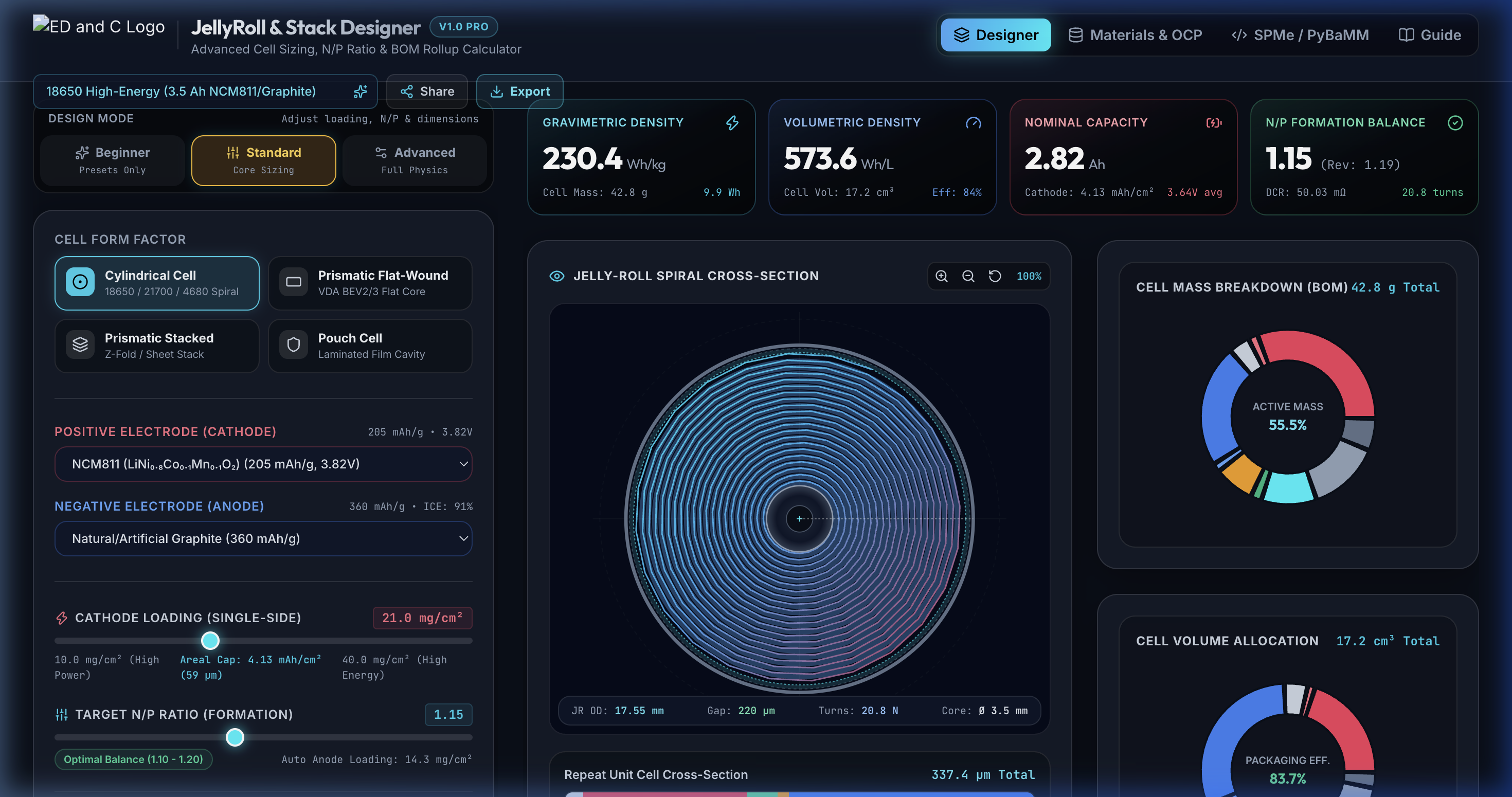
JellyRoll & Stack Designer Main Interface Figure 1: Main interactive designer with dual-pane layout, real-time KPI cards, and dynamic spiral visualizer.
Zero Server Latency: Designed for high-frequency parameter exploration and confidential prototype sizing. The entire mathematical model updates instantly upon every slider adjustment.

2. Multi-Form Factor Geometry: Winding & Stacking

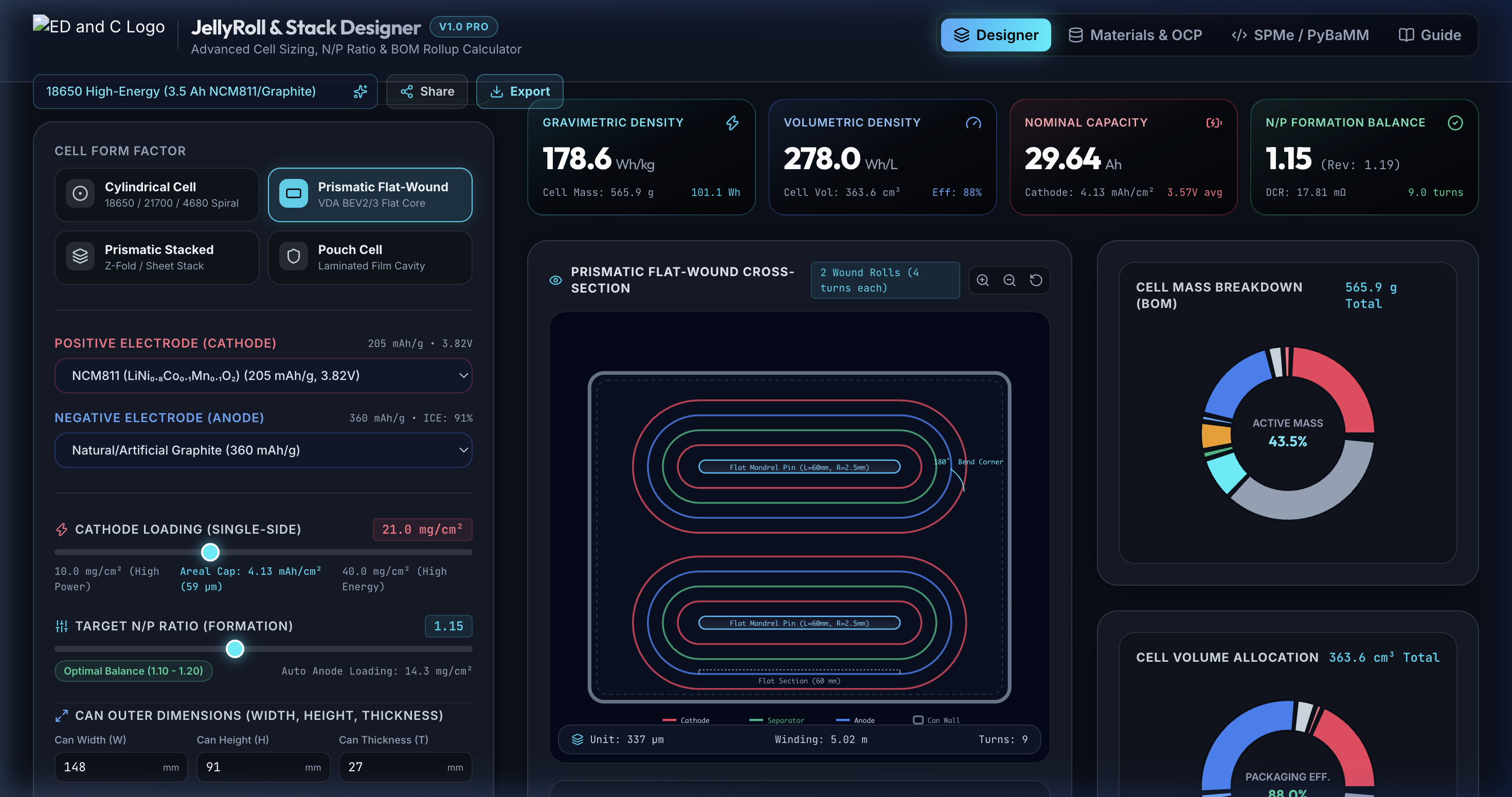
Flat-Wound Racetrack & Stack Geometry Figure 2: Cross-sectional SVG visualizers for flat-wound prismatic rolls and planar Z-fold stacks.

Commercial cells employ vastly different packaging paradigms. This application models each geometry with exact continuum equations:

Supported Packaging Paradigms

  • Cylindrical Spiral (18650, 21700, 4680): Analytical integration of Archimedean spiral arc-length around center mandrel pins (Dcore), accounting for radial can insertion clearance (δ = 150 ∼ 350 μm).
  • Prismatic Flat-Wound (VDA BEV2/3): Concentric racetrack (stadium) windings with straight flat segments and 180° rounded corners around flat mandrels.
  • Prismatic & Pouch Stacked: Planar sheet stacks and continuous Z-fold separator configurations featuring 4-sided anode overhang margins (1.5 ∼ 2.5 mm) and pouch seal borders.
Archimedean Arc Length: L = ∫ √(r² + a²) dθ (a = Tunit / 2π)
Unit Cell: Tunit = tAl + 2·tpos + 2·tsep + tCu + 2·tneg

3. 0D Voltage Profile & Continuous Tabless Topology

Terminal cell performance is simulated via a zero-dimensional (0D) equivalent circuit model parameterized by experimental Open-Circuit Potential (OCP) curves and DC Internal Resistance (DCR):
Resistance Components & Tabless Flagship

  • Foil Resistance (Rfoil): Captures ohmic conduction through aluminum and copper foils. In Continuous Tabless cells (e.g., 4680), current flows vertically along the short electrode height (~70 mm) rather than longitudinally along the multi-meter spiral length, reducing foil resistance by over 30×.
  • Ionic Electrolyte Resistance (Rionic): Governed by bulk conductivity (κ) and separator MacMullin tortuosity (NMac ≈ 4.5).
  • Interfacial Charge Transfer (Rct): Incorporates Butler-Volmer interfacial kinetics and solid-state diffusion overpotentials.
Vterminal(t) = Vocv(SOC) − I · (Rfoil + Rionic + Rct) − ηdiff
Gravimetric Density = Edischarge (Wh) / Total BOM Mass (kg)
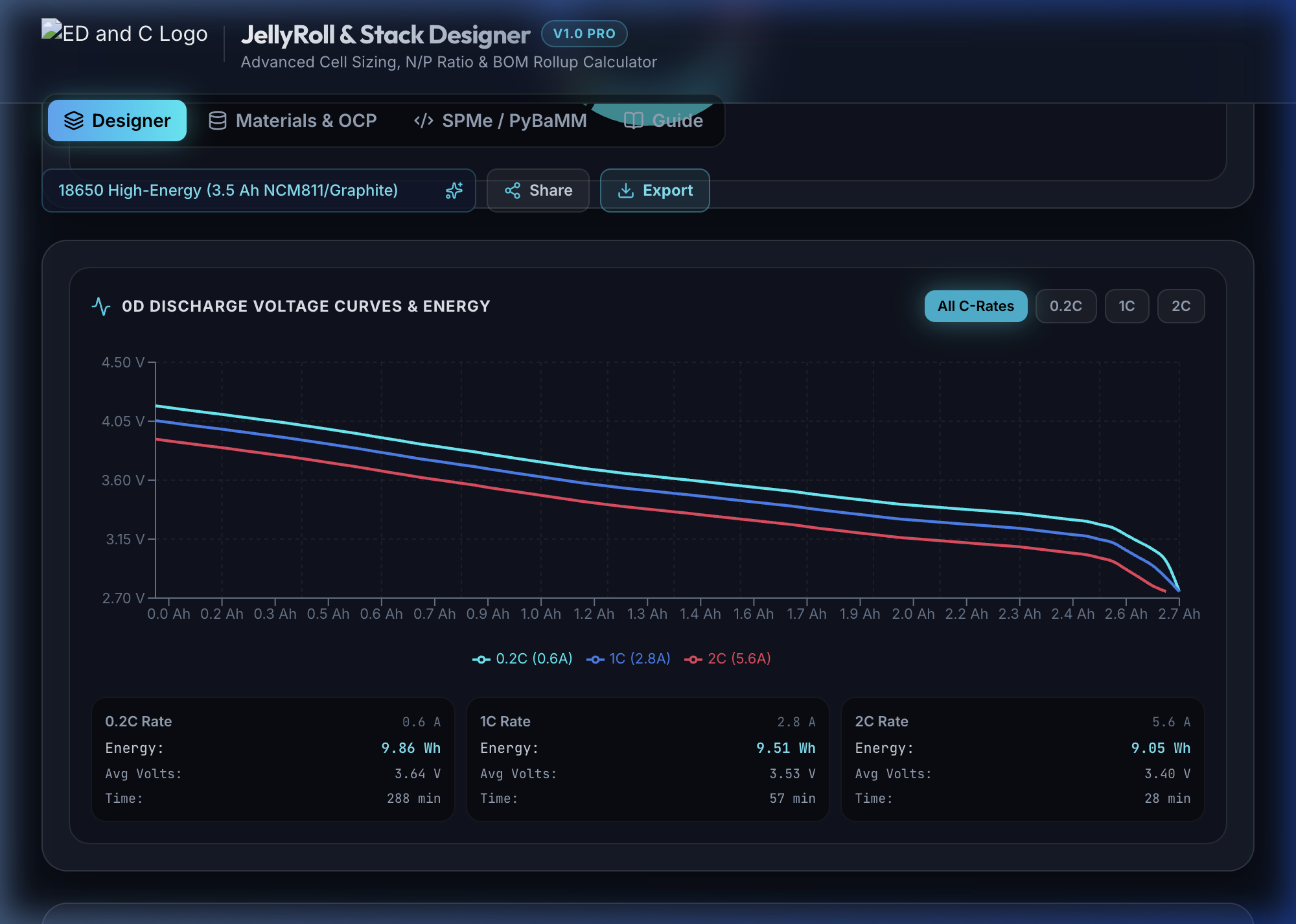
0D Discharge Curves at Multiple C-Rates Figure 3: Multi-rate discharge simulation (0.2C to 5C) displaying IR drop, plateau curvature, and cutoff points.

4. User Guide & Three Design Modes

The application adapts to varying levels of user expertise via the Mode Ribbon:

Design Modes

  • Beginner Presets Only: Instant 1-click loading of industry standard cells (Panasonic 18650-B, Samsung 21700-50E, Tesla 4680, VDA BEV2 Prismatic, and 60Ah Pouch). Ideal for quick KPI benchmarking.
  • Standard Core Sizing: Hands-on control over cathode loading sliders (10 to 40 mg/cm²), target N/P ratio, and outer casing dimensions with live visual feedback.
  • Advanced Full Physics Overrides: Engineering accordions for calendered porosities, active material weight fractions, foil gauges, mandrel diameters, insertion clearances, and casing wall thicknesses.

Export & Integration Capabilities

Designed to fit smoothly into professional R&D pipelines:

  1. SPMe / PyBaMM Export: One-click generation of runnable Python simulation scripts configured to PyBaMM's latest API.
  2. Materials & OCP Database: Interactive half-cell OCP curves vs. Li/Li⁺ for NCM811, NCM622, NCM523, LFP, NCA, Graphite, Si-Gr, and LTO.
  3. BOM & Report Export: Full JSON parameter export, clipboard URL sharing, and automated Bill-of-Materials CSV summaries.

5. Academic References & Acknowledgements

The electrochemical parameters, true crystal densities, and OCP data in this application are strictly derived from peer-reviewed literature and the PyBaMM (Python Battery Mathematical Modelling) open-source project. We express our sincere gratitude to the PyBaMM development team and international battery researchers.

Primary Modeling Framework

  • PyBaMM: Sulzer et al., "Python Battery Mathematical Modelling (PyBaMM)." Journal of Open Research Software, 9(1), 14 (2021). DOI: 10.5334/jors.309. pybamm.org

Key Literature Citations

  • Chen et al. (2020) [LG M50 21700]: "Development of Experimental Techniques for Parameterization of Multi-scale Lithium-ion Battery Models." J. Electrochem. Soc. 167: 080534.
  • Mohtat et al. (2020) [NCM622]: "Differential Expansion and Voltage Model for Li-ion Batteries at Practical Charging Rates." J. Electrochem. Soc. 167: 110561.
  • Marquis et al. (2019) [SPMe]: "An Upgraded Form of the Single-Particle Model with Electrolyte." J. Electrochem. Soc. 166: A3693.
  • Kim et al. (2011) [NCA]: "Multi-domain modeling of lithium-ion batteries encompassing multi-physics." J. Electrochem. Soc. 158: A955.
  • Prada et al. (2013) [LFP]: "A simplified electrochemical and thermal aging model of LiFePO4-graphite Li-ion batteries." J. Electrochem. Soc. 160: A616.
  • Ecker et al. (2015) [LTO]: "Parameterization of a physico-chemical model of a lithium-ion battery." J. Electrochem. Soc. 162: A1836.

Industry Benchmarks & Teardowns

1. 技術概要と中核設計思想 (Technical Overview)

JellyRoll & Stack Designer は、簡易なExcel計算シートと高価な電池CADツールの隙間を埋める、ブラウザ完結型の高精度リチウムイオン電池セル設計プラットフォームです。電池設計者、材料研究者、セルアーキテクトが電極容量バランス、ジェリーロール/積層幾何構造、部品表(BOM)質量・体積構成、セルエネルギー密度(Wh/kg, Wh/L)をリアルタイムに算出できます。

3つの基本思想

  • 100% クライアントサイド演算: すべての幾何構造積分、電気化学バランス、放電シミュレーションはお手元のブラウザ内で完結実行されます。外部サーバーへの通信は一切なく、機密性の高いセル仕様や活物質組成がネットワークに漏洩する心配はありません。
  • 真密度に基づく両面塗工バランス計算: 活物質の結晶理論密度(真密度)、導電助剤・バインダー比率、プレス後空隙率から、電極塗工厚み(tcoat)と両面目付量を厳密に算出します。
  • 初期効率(ICE)補正による形成N/P比: 初期充電化成時のSEI形成による不可逆容量消費を考慮し、負極上への金属リチウム電析(Liプレーティング)を確実に防止する形成時N/P比を自動判定します。
正極容量密度: Qpos = M″pos × wpos × qspec,pos × 10−3 (mAh/cm²)
形成時N/P比: NPform = ( Qneg / ICEneg ) / ( Qpos / ICEpos ) ≥ 1.10 – 1.20
アプリメイン画面 図1:左右独立スクロール・リアルタイムKPIカード・幾何断面ビューを備えた設計画面。
完全ローカル実行: スライダーを動かした瞬間に幾何学とエネルギー密度がゼロ遅延で再計算されます。試作検討やパラメータスタディを極めて高速に行えます。

2. マルチフォームファクターの幾何学モデリング(巻回・積層)

扁平巻回および積層幾何図 図2:角型扁平巻回(レーストラック)およびパウチ積層の断面SVG可視化。

市販リチウムイオン電池は多様なパッケージング形態を持ちます。本アプリでは各構造の物理幾何形状を連続体数理モデルにより再現しています:

対応するセル構造

  • 円筒型スパイラル(18650, 21700, 4680): 芯金ピン(Dcore)を中心とするアルキメデス螺旋の弧長積分により、正確な電極長と総巻回数を算出。鋼缶への自動挿入クリアランス(径方向片側 150 ∼ 350 μm)を確保します。
  • 角型扁平巻回(Prismatic Flat-Wound / VDA BEV2・BEV3): フラットマンドレルの直線部と180°円弧曲げ部からなるレーストラック(スタジアム型)周回幾何構造を算出。
  • 積層型(Pouch / Prismatic Stacked): シート積層およびZ-Foldセパレータ構成に対応。短絡防止のための4辺負極オーバーハングマージン(1.5 ∼ 2.5 mm)とシール幅を自動レイアウトします。
アルキメデス螺旋弧長: L = ∫ √(r² + a²) dθ (a = Tunit / 2π)
繰返し単位厚み: Tunit = tAl + 2·tpos + 2·tsep + tCu + 2·tneg

3. 0D放電シミュレーションと連続タブレス集電技術

セルの放電プラトー電圧と実効エネルギーは、学術測定された半電池開回路電位(OCP)と等価DC内部抵抗(DCR)を組み合わせた0D物理モデルにより予測されます:

内部抵抗の構成と4680タブレス

  • 金属箔導電抵抗 (Rfoil): アルミニウム箔・銅箔内の電子伝導。Tesla 4680等の連続タブレス構造では、数メートルに及ぶ長手方向ではなく、電極幅(高さ方向約70mm)の最短パスで全面集電するため、箔抵抗が30倍以上劇的に低減されます。
  • セパレータ液相抵抗 (Rionic): 電解液固有導電率(κ)とMacMullin屈曲率係数(NMac ≈ 4.5)に基づく多孔質イオン伝導損。
  • 電極界面反応抵抗 (Rct): Butler-Volmer式に基づく電荷移動過電圧および固体内リチウム拡散過電圧項。
端子電圧: V(t) = Vocv(SOC) − I · (Rfoil + Rionic + Rct) − ηdiff
重量エネルギー密度 = 放電積算エネルギー (Wh) / 総セル質量 (kg)
複数Cレート放電曲線 図3:0.2C〜5Cの多レート放電曲線シミュレーション(IRドロップとカットオフ電圧判定)。

4. 操作ガイドと3段階デザインモード

ユーザーの習熟度や設計目的に応じて、上部のMode Ribbonから3段階のモードを自在に切り替えられます:

設計モードの使い分け

  • Beginner Presets Only(初心者・即時確認): 市販代表セル(Panasonic 18650-B, Samsung 21700-50E, Tesla 4680, VDA BEV2角型, 60Ahパウチ)を1クリックで呼び出し。寸法や密度を即座に確認できます。
  • Standard Core Sizing(中級・主要諸元調整): 正極目付量スライダー(10〜40 mg/cm²)、目標N/P比、缶外形寸法の直接入力によるインタラクティブ設計。
  • Advanced Full Physics(上級・全物性オーバーライド): カレンダー空隙率、箔厚、芯金径、挿入クリアランス、缶肉厚、カットオフ電圧等の完全手動エンジニアリング。

研究・試作業務との連携機能

  1. SPMe / PyBaMMスクリプト出力: 現在の設計諸元をそのまま反映したPythonシミュレーションコードを1クリック生成。
  2. 材料物性・OCPデータベース: NCM811, NCM622, NCM523, LFP, NCA, 黒鉛, Si-Gr, LTO の開回路電位プロファイルを視覚的に比較。
  3. BOMおよび設計データの共有: 設計状態のJSONダウンロード、URLクリップボード共有、およびBOM内訳の確認。

5. 引用文献・工業規格とPyBaMMへの謝辞

本ソフトウェアに搭載されている物理定数、活物質真密度、電位関数は、国際的に評価の高い査読付き学術論文およびオープンソース電池モデリングプロジェクト PyBaMM のパラメータに基づいています。オープンサイエンスを推進するPyBaMMコミュニティに深く感謝申し上げます。

中核モデリングフレームワーク

  • PyBaMM: Sulzer et al., "Python Battery Mathematical Modelling (PyBaMM)." Journal of Open Research Software, 9(1), 14 (2021). DOI: 10.5334/jors.309. pybamm.org

主要学術論文リファレンス

  • Chen et al. (2020) [LG M50 21700セル]: "Development of Experimental Techniques for Parameterization of Multi-scale Lithium-ion Battery Models." J. Electrochem. Soc. 167: 080534.
  • Mohtat et al. (2020) [NCM622車載パウチ]: "Differential Expansion and Voltage Model for Li-ion Batteries at Practical Charging Rates." J. Electrochem. Soc. 167: 110561.
  • Marquis et al. (2019) [SPMe電解液過電圧]: "An Upgraded Form of the Single-Particle Model with Electrolyte." J. Electrochem. Soc. 166: A3693.
  • Kim et al. (2011) [NCA電位関数]: "Multi-domain modeling of lithium-ion batteries encompassing multi-physics." J. Electrochem. Soc. 158: A955.
  • Prada et al. (2013) [LFP相転移平坦プラトー]: "A simplified electrochemical and thermal aging model of LiFePO4-graphite Li-ion batteries." J. Electrochem. Soc. 160: A616.
  • Ecker et al. (2015) [LTO超急速充電]: "Parameterization of a physico-chemical model of a lithium-ion battery." J. Electrochem. Soc. 162: A1836.

工業ベンチマーク・規格参照元