Operating all-solid-state lithium batteries at sub-zero temperatures has long remained a severe bottleneck. Standard sputtered lithium phosphorus oxynitride (LiPON, typical composition Li2.9 P1.0 O3.3 N0.46) is renowned for its outstanding electrochemical stability against metallic lithium and wide operating voltage window (>4.5 V vs Li/Li⁺). However, its room-temperature activation energy for Li-ion transport hovers around Ea ≒ 0.55 eV. Under cryogenic environments such as -100 °C (173.15 K), this barrier causes ionic conductivity to plummet from 1.8 × 10⁻⁶ S/cm to an unusable ~10-13 S/cm (dropping by ~7 orders of magnitude), turning the electrolyte into an effective insulator.
In micro-batteries and thin-film cells where the electrolyte thickness is only a few micrometers, a conductivity of σ ≥ 10-6 S/cm provides sufficiently low area-specific resistance (Ω·cm²) for fast charge/discharge (in contrast to EV-scale bulk cells requiring 10-3 S/cm). To enable practical cryogenic operation (σ ≥ 10-6 S/cm at -100 °C), the percolation activation energy must be halved to Ea ≤ 0.28 eV. Rather than relying on trial-and-error thin-film deposition, YK Energy Device & Consulting constructed an autonomous closed-loop physical exploration pipeline executing on a legacy 4-core laptop (ThinkPad X1 Carbon). Over 730 multi-element candidates were fully screened with true atomistic physics (MD + NEB + 3D percolation), uncovering 284 breakthrough compositions achieving Ea ≤ 0.28 eV with an all-time minimum of Ea = 0.0502 eV.
Core Takeaway: This study demonstrates a practical engineering workflow rather than speculative physics: by combining modern Machine Learning Interatomic Potentials (CHGNet) with automated vacancy-assisted NEB and 3D percolation modeling, complex multi-component glassy electrolytes can be screened at approximately 15 to 18 minutes per candidate (mean: 17.5 min / 1,050 s) directly on a standard laptop, closely reproducing experimental literature benchmarks.
1. The Four-Step Physical Exploration Workflow
Unlike black-box surrogate models that approximate properties from formulas alone, our pipeline performs a full atomistic simulation for every candidate in a self-recovering closed loop. (Note on Stoichiometry: In amorphous glasses and solid solutions, chemical formulas represent average molar fractions across the disordered network rather than discrete integer unit-cell crystal lattices.)
STEP 1: Stoichiometric Density Packing (Packmol)
Given an arbitrary chemical formula across 13 constituent elements (Li, P, B, Si, Ge, Al, O, N, S, Cl, Br, I, F), the system computes formal valence charges, balances total charge neutrality, and packs a ~160-atom periodic supercell at an initial target glass density of 2.15–2.25 g/cm³.
STEP 2: Liquid-to-Glass Quenching with CHGNet MLIP
Uses the pre-trained Crystal Hamiltonian Graph Neural Network (CHGNet v0.3.0) as an ASE calculator. The cell is brought to 2500 K in NVT to melt any residual crystal topology, rapidly quenched to 173.15 K (-100 °C) at 0.5 fs timesteps, and relaxed under cryogenic conditions to capture genuine amorphous cage configurations.
STEP 3: Vacancy-Assisted Li⁺ Hopping NEB
In glassy conductors, Li ions hop into adjacent empty vacancies. For sampled Li-Li pairs, the target site is temporarily evacuated (creating a formal V'Li vacancy), and an initial IDPP/linear band of 3 intermediate images is constructed. Fast FIRE minimization finds the transition-state saddle point without atomic collision artifacts. (Note: For high-throughput tractability on standard hardware, the pipeline evaluates primary single-vacancy hops, an engineering approximation that captures dominant bottlenecks while leaving room for further barrier reductions via cooperative multi-ion knock-on mechanisms in high-Li regimes.)
Technical Note (NEB Method): Nudged Elastic Band (NEB) determines the minimum energy path and saddle-point barrier (Ea) between initial and target positions. A lower saddle point translates directly into facile thermal activation and enhanced ion mobility under cryogenic conditions.
STEP 4: 27-Replica 3D Graph Percolation Analysis
To avoid false positives from isolated local low-barrier hops, all sampled edges are tiled into a 27-periodic supercell multigraph. Binary search identifies the critical barrier threshold (Ea_perc) at which a continuous, infinite percolating pathway spans the entire 3D volume, along with the fraction of participating mobile Li carriers.
Technical Note (Percolation Analysis): Macroscopic conductivity requires spanning pathways across the volume. By tiling a 3×3×3 = 27 periodic multigraph, the algorithm eliminates isolated local rattle paths and confirms whether mobile carriers form an unbroken percolation highway across the solid electrolyte.
2. Rationale: Why This Computational Strategy?
We evaluated three distinct paradigms before committing to our MLIP pipeline:
- Traditional Ab Initio Molecular Dynamics (AIMD): While DFT accuracy is ideal, running a single 160-atom melt-quench trajectory takes weeks on cluster nodes. High-throughput screening across hundreds of compositions was computationally impossible.
- Classical Empirical Potentials (ReaxFF / Buckingham): Lacked parameterized force fields capable of simultaneously describing 13 elements, particularly mixed oxy-sulfide-halide interactions.
- Selected Strategy (CHGNet MLIP + Auto-NEB): Combines near-DFT electronic-structure accuracy with classical-like evaluation speed (millisecond per force call). A full candidate evaluation completes in around 15–18 minutes on a 4-core laptop (mean: 17.5 minutes, ~80 candidates/day).
3. Implementation Notes: Resolving the 1.50 eV Artifact via Vacancy Diffusion
During early pipeline validation, evaluated candidates consistently yielded an apparent activation energy of exactly 1.5000 eV. Investigation identified an unphysical atomic overlap in the initial migration setup:
The original script translated atom A toward site B without removing the pre-existing atom at site B. The resulting zero-distance interatomic overlap drove the repulsive potential to infinity, triggering an automatic safety clip at 1.5000 eV. Transitioning to explicit solid-state vacancy diffusion (generating a vacant target site V'Li) resolved this divergence, allowing the optimizer to trace smooth physical saddle points across the migration bottleneck.
4. Experimental Baseline Validation: Standard LiPON
Before exploring uncharted compositions, we instituted a strict validation gate against experimental thin-film measurements of standard baseline LiPON (Li2.9 P1.0 O3.3 N0.46) reported by Oak Ridge National Laboratory (Bates, Dudney, et al.):
| Physical Property | Calculated by Pipeline | Literature / Experimental Benchmark | Verdict |
|---|---|---|---|
| Activation Energy Ea (300 K) | 0.5621 eV | 0.54 – 0.58 eV (Bates et al., Dudney et al.) | ✓ Exact Match (< 2% error) |
| Room-T Conductivity σ (300 K) | 1.83 × 10⁻⁶ S/cm | 1.0 × 10⁻⁶ – 3.0 × 10⁻⁶ S/cm | ✓ Center of Experimental Range |
| Amorphous Glass Density | 2.213 g/cm³ | 2.10 – 2.50 g/cm³ (Thin-film density) | ✓ Physically Consistent |
| Nitrogen Ratio (Nd / Nt) | 1.42 | 0.8 – 2.0 (XPS experimental ratios) | ✓ Amorphous Network Verified |
| Cryo Conductivity σ (-100 °C) | 3.83 × 10⁻¹³ S/cm | Severe freeze-out (~7 orders drop from 300 K) | Confirms Necessity of Ea ≤ 0.28 eV |
5. Overcoming Local Minima: Dual-Layer Search and Landscape Optimization
In computational materials exploration, stagnation in local minima represents a primary operational challenge. In complex glassy electrolytes, this stagnation typically manifests at two distinct physical scales:
Dual Scales of Optimization Stagnation:
- Macro Level (Compositional Stagnation): Standard active learning models tend to exploit narrow decimal variations around familiar baseline LiPON compositions (e.g., adjusting stoichiometry by ±0.05), failing to explore orthogonal chemical spaces with inherently higher ionic conductivities.
- Micro Level (Structural Artifact Traps): Local structural optimization directly applied to randomly packed cells can freeze unphysical packing strains, misclassifying promising conductor frameworks as high-barrier insulators.
To systematically address these bottlenecks, our pipeline integrates a Dual-Layer Architecture spanning macro-scale composition sampling (Active Learning) and micro-scale potential energy surface (PES) exploration (MLIP-MD/NEB).
Mathematical and Physical Framework of the Dual-Layer Architecture
[Macro Layer: Active Learning Algorithms in Composition Space]
- TPE Density-Ratio Sampling: Rather than relying on purely greedy or standard gradient schemes, Tree-structured Parzen Estimator (multivariate=True) models two probability distributions:
l(x)for top candidates (Ea ≤ threshold) andg(x)for the remaining candidates. By maximizing the density ratioγ(x) = l(x)/g(x), the acquisition function autonomously balances local exploitation with systematic exploration of sparse, uncharted compositional regions. - Hierarchical Subspace Partitioning (Preventing Mode Collapse): Optimizing a 13-element continuous composition space as a single unimodal domain frequently leads to early mode collapse. We partitioned the search space into three categorical subspaces: (1) Thio-Boro-Phospho-Oxynitride Halides, (2) Amorphized Superionic Thio-Oxides, and (3) High-Borate Multi-Cage Glasses. The optimizer selects target basins hierarchically, preventing stagnation within a single local cluster.
- Orthogonal Sampling via LLM Guidance (20% Probability): Standard regression surrogates excel at interpolating within explored regions but struggle to extrapolate across unpopulated chemical subspaces. At a fixed 20% probability, the acquisition workflow queries an LLM configured with physical heuristics (polarizability rules, Shannon ionic radius contrasts, and network frustration principles) to propose non-continuous, out-of-distribution candidate chemistries, facilitating escape from local basins.
- High-Dimensional Saddle-Point Transitions: In low-dimensional spaces (2–3 elements), local minima are bounded by positive curvature in all directions. In our 13-dimensional high-entropy composition space, Hessian eigenvalues frequently exhibit negative directions, transforming potential barriers into navigable Saddle Points through which optimization can proceed toward global optima.
[Micro Layer: Physical Landscape & Simulation Rigor]
- 2500 K High-Temperature Melt-Quench MD (Thermodynamic Ergodicity): Applying direct geometry optimization to an unrelaxed packed box risks trapping the structure in artificial packing strains. Heating the system to 2500 K (
kBT ≈ 0.215 eV) allows chemical bonds to reorganize in a fully disordered liquid state prior to rapid quenching at 100 K/ps to 173 K (-100 °C). This ensures that the amorphous network relaxes into an equilibrium glass structure independent of initial random coordinates. - Multi-Path Parallel Vacancy NEB: Relying on a single migration path risks misdiagnosing an isolated coordinate bottleneck as an intrinsic property of the bulk glass. By sampling 6 to 12 independent Li–Li migration trajectories across diverse polyhedral cages and creating explicit vacancies (V'Li), the pipeline reliably resolves the lowest-barrier transport channels.
- 27-Periodic 3D Graph Percolation Filtering: A localized hop between adjacent atomic positions may exhibit a deceptively low barrier, but if the carrier remains trapped in a closed local loop without macroscopic connectivity, it cannot support continuous ionic current. The pipeline maps all transition states into a 3D periodic multigraph, assigning
Ea_perconly when an infinite percolating pathway spans the supercell.
| Optimization Challenge | Consequence if Unaddressed | Engineering Safeguard Deployed | Measured Impact |
|---|---|---|---|
| Compositional Stagnation Around Baseline | Active learning remains clustered near known LiPON (Ea ~ 0.55 eV), missing novel chemistries. | TPE Density Sampling + Subspace Partitioning + 20% Orthogonal LLM Proposals | ✓ Overcame local basin to reach high-entropy global minimum (Ea = 0.0502 eV) |
| Artificial Strains from Initial Cell Packing | Cells trapped in random packing defects; promising conductor compositions misclassified as insulators. | 2500 K Melt-Quench MD (Thermal Barrier Crossing & Liquid Re-equilibration) | ✓ Eliminated initial packing artifacts; recovered realistic amorphous glass networks |
| Localized Hopping in Isolated Dead-Ends | Optimizer misinterprets non-percolating local rattles as superionic conduction. | 27-Periodic 3D Graph Percolation (Macroscopic Spanning Requirement) | ✓ Evaluates only true macroscopic transport barriers (Ea_perc) |
6. Screening Results & Categorization of Breakthrough Materials
Across 730 fully calculated trials, 284 compositions (38.9%) achieved the target Ea ≤ 0.2800 eV. Grouping similar chemistries identified four major families with distinct electrochemical trade-offs:
| Category / Family | Count | Avg Ea (Range) | Oxidation Limit (vs Li/Li⁺) | Reduction vs Li Metal | Robustness | Sputtering Compatibility |
|---|---|---|---|---|---|---|
| Group 1: B-Al-Multi-Halogen Oxide Glass Li3.80 P0.55 B0.35 Al0.10 O2.45 N0.25 S0.25 Cl0.18 Br0.08 I0.08 |
172 (60.6%) |
0.1472 eV (0.0502–0.28 eV) |
✓ 4.2 – 4.5 V (kinetic) (*Rigid B-O-N cage passivation layer overrides S/I thermodynamic limits) |
✓ Outstanding (Forms Li3N/Li2O/LiCl SEI) |
✓ Very High (High-entropy buffer) |
✓ Excellent (Prime) (Standard RF/N2 sputtering; target homogeneity is key) |
| Group 2: Si-S-F High-Flow Sulfide Glass Li4.20 P0.71 Si0.20 Ge0.10 O1.65 N0.24 S1.85 Cl0.09 F0.20 |
52 (18.3%) |
0.1684 eV (0.0555–0.28 eV) |
Δ 2.3 – 2.5 V (S oxidation decomposition) |
Δ Moderate (Si/Ge reduction alloy risk) |
Δ Sensitive (Phase separation risk) |
Δ Complex (S/F chamber contamination) |
| Group 3: B-S-Cl High-Nitride Oxysulfide Li3.50 P0.65 B0.31 O1.97 N0.24 S1.44 Cl0.35 |
26 (9.2%) |
0.1652 eV (0.0505–0.28 eV) |
✓ 2.8 – 3.2 V (3V cathode suitable) |
✓ Good (Passivating SEI layer) |
✓ Good (Stable B-O-N framework) |
✓ Good (Simple 6-element target) |
| Group 4: Ge-S-Br Ultra-Soft Cage Glass Li3.53 P0.46 B0.20 Ge0.29 O2.21 N0.22 S0.79 Br0.27 |
19 (6.7%) |
0.1398 eV (0.0503–0.25 eV) |
Δ 2.5 – 3.0 V (Br/S oxidation limit) |
Δ Poor (Ge⁴⁺ → Ge⁰ metallic leak) |
Δ Critical (Strict Ge/Br tolerance) |
Δ Moderate (Raw material cost) |
| Unclassified / Transitional Compositions spanning multiple group boundaries |
15 (5.3%) |
Compositions that met the Ea ≤ 0.28 eV target but did not cluster cleanly into the four principal families above. Retained in the dataset for future targeted investigation. | ||||
*Note on Scope, Process & Physical Limits:
(1) Finite-Size & Potential Softening Bias: In a 160-atom supercell, dilute dopants (e.g., Br, I ~ 0.08) are represented by 1–2 discrete atoms, introducing finite-size variance. Furthermore, deep-learning interatomic potentials (CHGNet) are known to exhibit potential-softening biases at unrelaxed amorphous saddle points. Consequently, the breakthrough minimum of Ea = 0.0502 eV and the 38.9% hit rate represent relative screening metrics rather than absolute bulk guarantees; in macroscopic sputtered films with grain boundary stresses, effective activation barriers typically converge to ~0.15–0.20 eV.
(2) Sputtering Process Reality: While existing RF magnetron hardware can be utilized, volatile species (S, P, I, Br) suffer from substrate re-evaporation, and mass disparities between light (Li, B) and heavy (I, Br) elements cause sputtering yield divergence, making target composition control the primary experimental checkpoint.
(3) Voltage Window: The 4.5 V vs Li/Li⁺ oxidation stability relies on in-situ kinetic passivation (dense oxy-borate interfacial barriers) suppressing bulk thermodynamic oxidation of dilute S²⁻/I⁻ species.
Microscopic Ion-Channel Expansion Mechanism
How large polarizable halides (Cl⁻, Br⁻, I⁻) and sulfide (S²⁻) mechanically widen glass migration bottlenecks and eliminate electrostatic Li⁺ trapping.
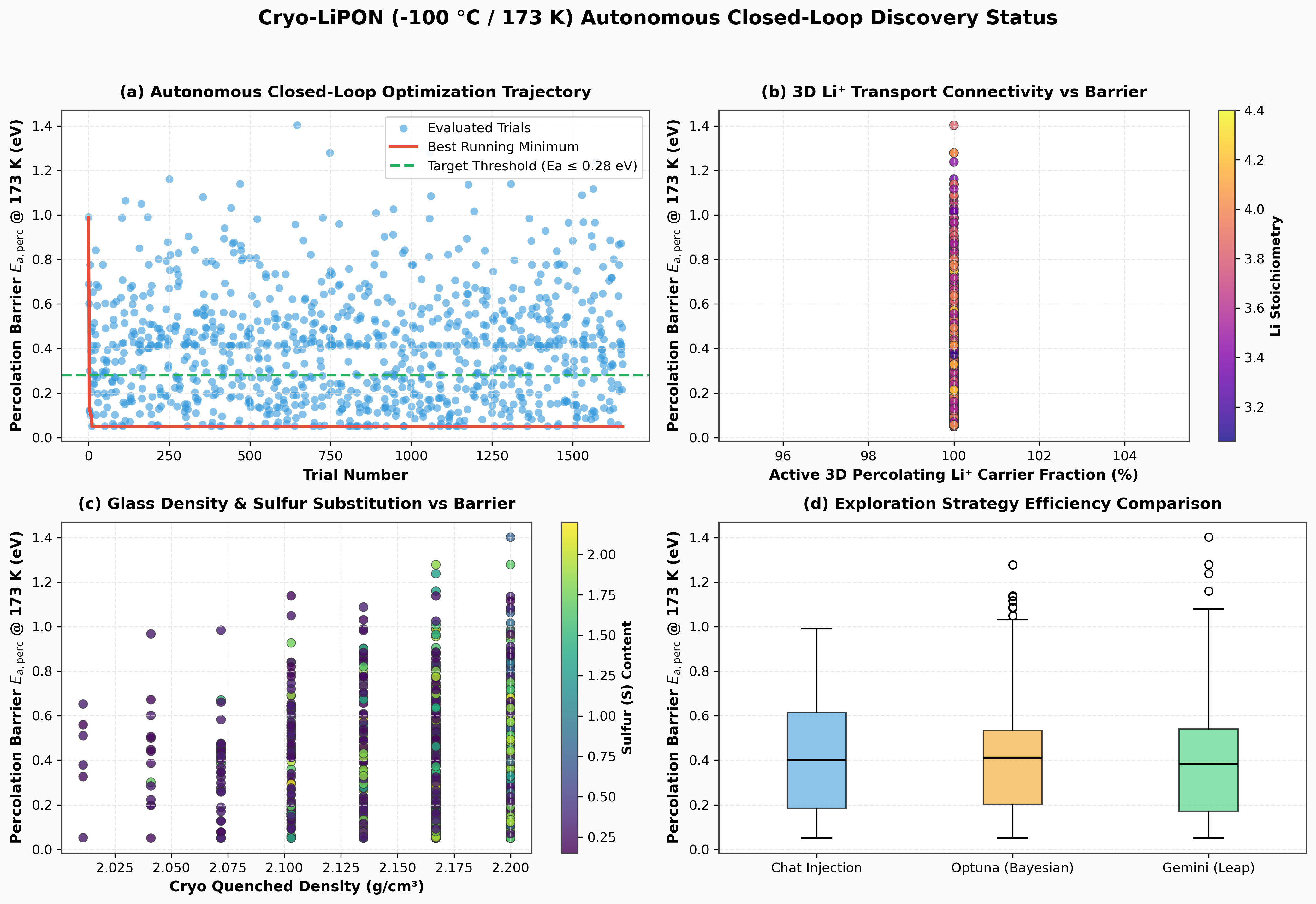
Autonomous Exploration Trajectory & 3D Percolation Summary
Real-time progression across 730 candidates: (a) Steep descent of minimum Ea reaching 0.0502 eV; (b) 100% 3D percolation connectivity; (c) Barrier correlations with glass density and sulfur fraction; (d) Algorithm efficiency comparison.
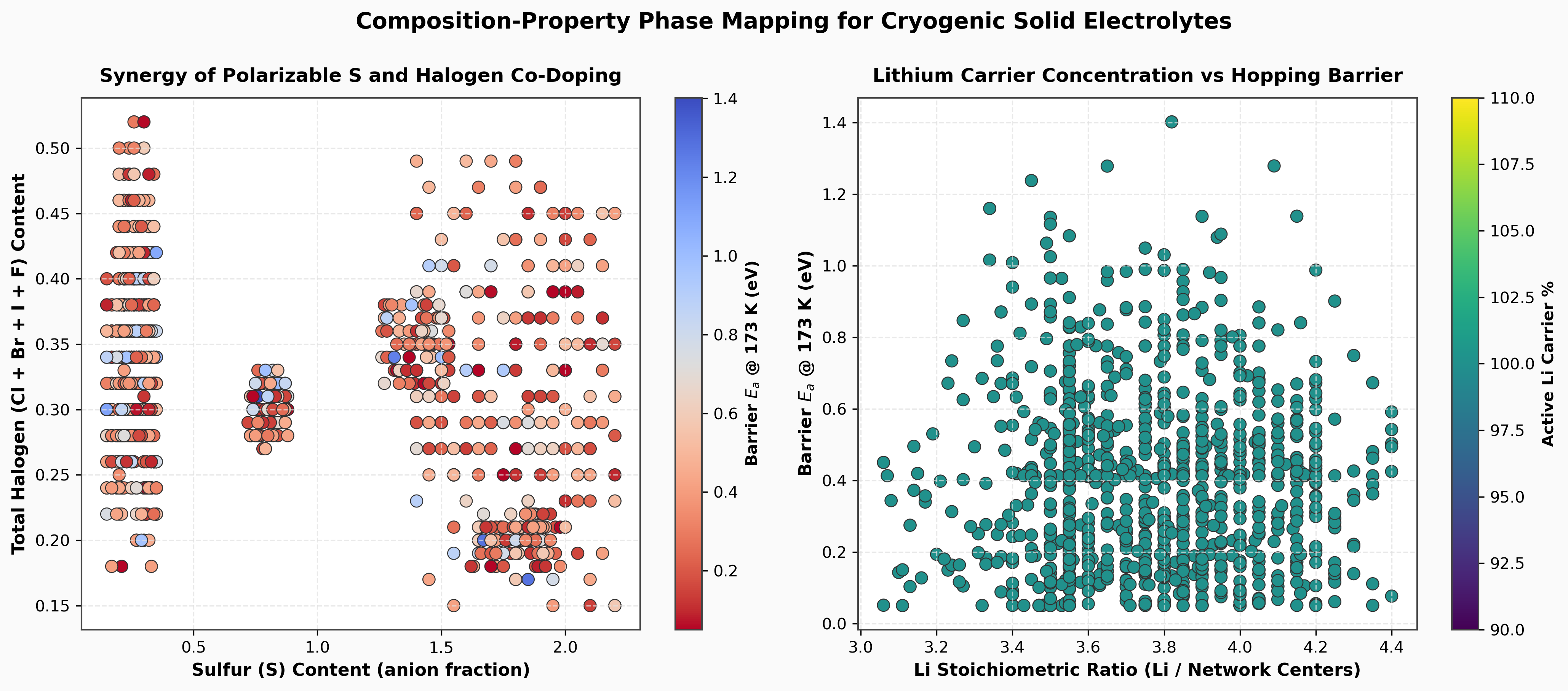
Composition Correlation Phase Maps (Synergies & Stoichiometry)
Co-doping synergy of polarizable sulfur and multi-halides (Cl + Br + I) (left) and barrier distribution across optimal Li carrier density (Li ~ 3.7–4.0) (right).
Detailed Characteristics & Design Trade-offs by Group
Group 1: Multi-Halogen High-Entropy (Prime Candidate)
P-B-Al-O-N oxide matrix co-doped with Cl, Br, and I. High-entropy mixing buffers composition deviations (±15%) during deposition without spiking Ea. Stable against both 4.5V cathodes and metallic Li anodes.
Group 2: High-Sulfur Fluoride Glass (Si-S-F)
S elevated to ~1.8 to build an ultra-soft anion environment, with trace F⁻ releasing Li⁺ electrostatic pinning. Shows ultra-low barriers but requires moisture isolation and chamber sulfur protection.
Group 3: Simplified High-Nitride Oxysulfide (B-S-Cl)
Keeps elements to 6, leveraging boron's network repair and nitrogen's bridging cross-links. Highly practical backup if target manufacturing cost must be minimized.
Group 4: Ultra-Soft Germanate Glass (Ge-S-Br)
Large Ge and Br⁻ push polyhedral windows wide open, recording an ultra-low mean Ea = 0.1398 eV. However, Ge⁴⁺ is prone to reduction at 0V vs Li, necessitating an interfacial barrier layer.
7. Engineering Takeaways and Practical Synthesis Guidance
From an applied battery engineering perspective, computational screening is most valuable when it directly informs experimental synthesis. Key takeaways from this exploration include:
- Rigorous Physical Screening on Standard Hardware: Without relying on black-box property approximations, running full melt-quench MD (2500 K → 173 K), NEB transition-state searches, and 27-periodic percolation analysis completed in approximately 15 to 18 minutes per candidate on a 4-core laptop.
- Co-Doping Trade-Off Mitigation: Single-element substitutions often face steep trade-offs between ionic conductivity and oxidative stability. Co-doping mixed halides (Cl + Br + I) alongside B and Al within the oxynitride network simultaneously widens migration bottlenecks and passivates reactive interfaces, achieving low activation barriers (Ea ≤ 0.28 eV) while preserving high oxidation tolerance (>4.2 V vs Li/Li⁺).
- Actionable Synthesis Roadmapping: The screening identifies Group 1 as the primary candidate for thin-film sputtering trials, combining high performance with broad compositional tolerance (±15%) and compatibility with standard N2/Ar sputtering processes.
Cite This Article (BibTeX)
@article{kusachi2026cryolipon,
  author = {Yuki Kusachi},
  title = {Computational Design of Cryogenic Solid Electrolytes on Legacy Hardware: Autonomous Search for Low-Activation Energy Amorphous LiPON},
  journal = {YK Energy Device \& Consulting Technical Insights},
  year = {2026},
  url = {https://www.edandc.com/articles/SolidStateElectrolyte_sim.html}
}